
By the first Monday after an acquisition closes, finance may already be managing two payroll systems, two close calendars, different charts of accounts, and competing reporting expectations. Leadership, meanwhile, may be asking for one consolidated view of performance.
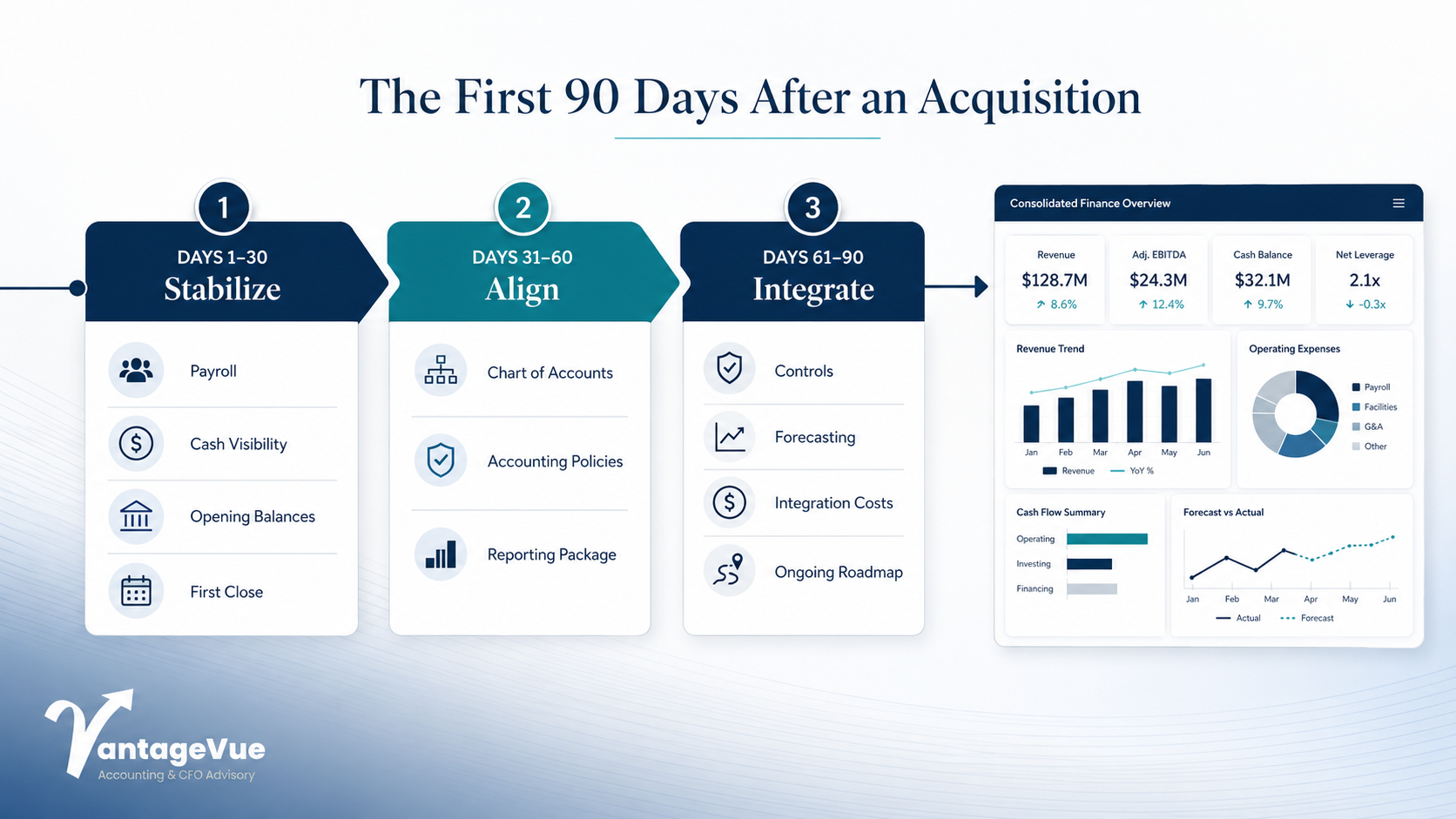
A practical post-acquisition finance integration plan helps the team stabilize essential work first, align accounting and reporting next, and build a more repeatable operating rhythm over the first 90 days.
This does not mean replacing every system and process immediately. Moving too quickly can disrupt payroll, create reporting errors, and place unfamiliar responsibilities on teams before the right controls are in place.
The first 90 days should give leadership something more useful than the appearance of rapid integration: reliable financial information, clear ownership, and a realistic plan for the work that remains.
Days 1–30: Stabilize the Essentials
The first month is about continuity. Payroll must run, cash must remain visible, bills and collections must continue, and the first post-acquisition close needs a workable plan.
Clear ownership keeps critical finance work from being delayed or left between teams.
Assign responsibility before work falls between teams
Every important finance activity needs a clear owner.
The buyer and acquired business should know who performs the work, who reviews it, and who can make decisions when the two companies follow different procedures.
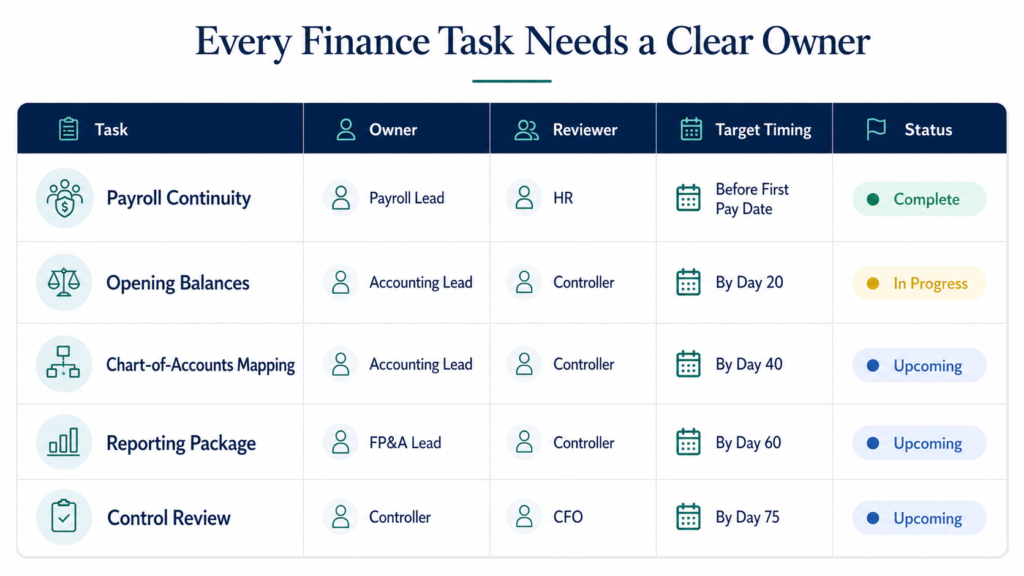
A simple responsibility tracker can help:
| Integration area | Primary owner | Review owner | Target timing |
| Payroll continuity | Payroll lead | Controller and HR | Before first pay date |
| Opening balances | Accounting lead | Controller | By Day 20 |
| Chart-of-accounts mapping | Accounting lead | Controller | By Day 40 |
| Reporting package | FP&A lead | CFO | By Day 60 |
| Control review | Controller | CFO | By Day 75 |
The names and titles will vary by transaction, but responsibility cannot be left between teams. When both sides assume the other is handling an activity, missed approvals and delayed work usually follow.
Protect payroll and cash operations
Immediate system consolidation can wait. Payroll cannot.
Before the first post-close pay date, confirm who processes payroll, who approves it, and how errors or employee questions will be handled. Review payroll calendars, bonuses, commissions, benefits, deductions, tax responsibilities, and the accounts used to record payroll-related liabilities.
The acquired company may remain on its existing payroll platform temporarily. That can be the safer choice when the current process is understood and working.
Finance also needs visibility into cash. Confirm bank access, payment authority, cash-reporting expectations, and any restrictions introduced by the transaction or financing arrangements.
The immediate objective is not to create the final treasury model. It is to prevent interrupted payments, unclear approvals, or cash accounts that leadership cannot see.
Prepare for the first close
The buyer and acquired company may use different close dates, reconciliation standards, and review procedures.
Establish a first close calendar that identifies:
- Transaction cutoffs
- Reconciliation and journal-entry deadlines
- Intercompany activity
- Consolidation work
- Review responsibilities
- Management-reporting dates
The first close may take longer than the buyer’s normal process, especially when the acquired finance team is working with unfamiliar requirements.
A slightly later close with supported balances is more useful than an early close that leadership cannot rely on.
The detailed accounting and reporting decisions involved in that process can be addressed through an internal link to VantageVue’s article, The First Financial Close After an Acquisition: Five Decisions That Shape the Integration.
Validate opening balances and begin account mapping
Opening balances become the starting point for future reporting. Finance should compare them with the transaction records and identify unusual, unsupported, or unreconciled amounts.
Cash, receivables, inventory, fixed assets, accrued expenses, deferred revenue, debt, payroll liabilities, intercompany balances, and equity accounts may all require review.
Not every issue will be settled during the first month. Anything unresolved should be documented, assigned, and tracked instead of being carried forward without explanation.
At the same time, begin mapping the acquired company’s chart of accounts to the buyer’s reporting structure.
The first step is usually mapping, not replacement. Finance needs to understand where accounts align, where definitions differ, and how the acquired company’s results will appear in consolidated reporting.
Days 31–60: Align Accounting and Reporting
Once payroll, cash visibility, and the first close are under control, attention can shift toward consistency.
The second month should make the numbers easier to compare and the reporting more useful to leadership.
Refine the chart-of-accounts mapping
The first account map may be enough to support an initial consolidation, but it is rarely the final design.
Review duplicate accounts, inconsistent classifications, department structures, revenue categories, cost groupings, intercompany accounts, and reporting dimensions.
Some legacy accounts may remain temporarily. The combined structure still needs to support consistent reporting.
Changes should be introduced carefully. Rebuilding the chart of accounts before the acquired business is fully understood can create cleanup work and make historical comparisons harder.
Address material accounting and data differences
Two businesses may handle the same transaction differently.
Differences may appear in revenue recognition, expense accruals, capitalization thresholds, prepaid expenses, reserves, inventory costing, commission treatment, fixed-asset lives, or intercompany activity.
Prioritize the differences that materially affect reporting, compliance, or management decisions.
Some policies may need immediate alignment. Others can remain temporarily when the difference is documented and adjusted during consolidation.
Data definitions also need attention. Terms such as “gross margin,” “active customer,” “recurring revenue,” or “headcount” may not mean the same thing across both organizations.
Before combining those metrics, confirm:
- What is included
- Which system provides the data
- Who owns the calculation
- How often it is updated
- Whether prior-period results remain comparable
Combining numbers without aligning their definitions can give leadership a consolidated report that looks precise but is difficult to interpret.
Build the management-reporting package
Leadership needs more than two income statements placed beside one another.
The reporting package should provide a useful view of the combined business and explain what changed. Depending on the organization, it may include:
- Consolidated financial statements
- Cash-flow and liquidity updates
- Actual-versus-budget reporting
- Revenue and margin by business unit
- Working-capital indicators
- Integration costs
- Key operating metrics
- Material adjustments and unresolved items
Variance explanations are especially important during integration.
A change in performance may come from the acquired business, purchase-related accounting, integration spending, account reclassification, or timing differences. Reporting should help leadership separate those causes rather than leaving them to interpret a single consolidated number.
Days 61–90: Build the Operating Rhythm
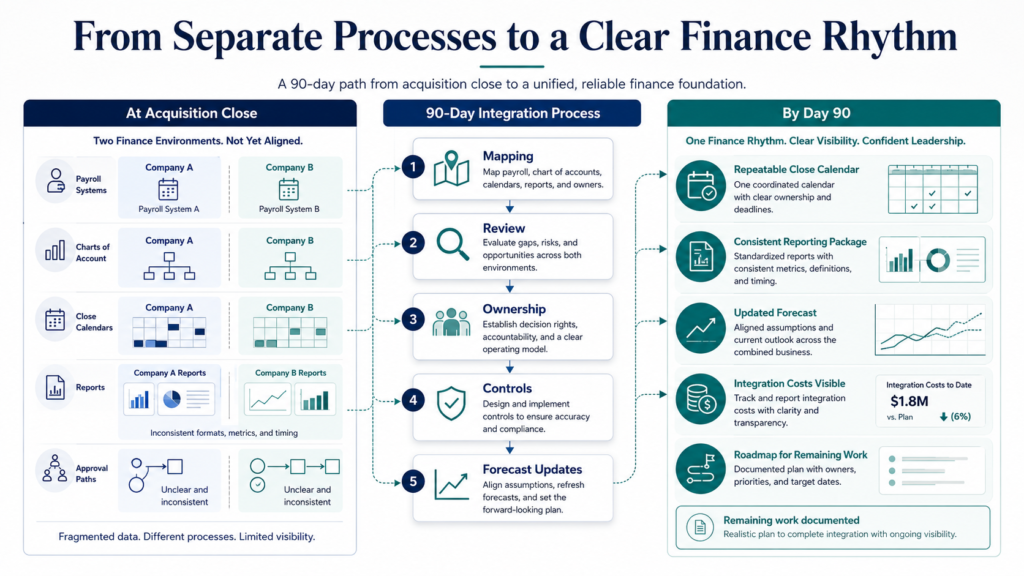
By the third month, finance should begin moving from temporary workarounds toward a repeatable operating model.
The integration may still have a long way to go, but close, reporting, forecasting, and control responsibilities should be becoming more predictable.
Day 90 does not require complete integration, but leadership should have reliable reporting, visible ownership, and a clear plan forward.
Standardize the close and strengthen controls
Use the first two closes to identify where the process struggled.
Review missed deadlines, unsupported reconciliations, manual adjustments, unclear approvals, and activities that depend heavily on one person.
Then decide which procedures should be standardized, which can remain temporarily separate, and which need stronger review.
Controls deserve particular attention because early integration often involves temporary access, spreadsheets, and unfamiliar approval paths.
Priority areas may include:
- Bank and system access
- Payment and payroll approvals
- Journal entries and reconciliations
- Billing and revenue controls
- Vendor setup
- Segregation of duties
- Report preparation and review
Temporary controls should have an owner and a target date for replacement or formalization. Without that plan, temporary workarounds can quietly become the normal process.
Update the forecast and track integration economics
The acquisition may have changed revenue expectations, staffing costs, working-capital needs, debt service, cash requirements, and integration spending.
The combined forecast should reflect the new operating reality rather than simply adding together the companies’ previous budgets.
Review assumptions for revenue, margins, payroll, vendor costs, capital expenditures, working capital, financing, integration expenses, and expected synergies.
Integration costs should be tracked separately where practical. Systems migration, advisers, employee retention, severance, training, duplicate software, travel, and process redesign can otherwise disappear into normal operating accounts.
Expected benefits need the same discipline.
Separate confirmed savings from future opportunities. Assign owners, assumptions, and target dates so leadership can see what has been achieved and what still depends on further action.
Build the roadmap beyond Day 90
Ninety days is a management milestone, not a promise that every system and process will be fully integrated.
Remaining work may include:
- Accounting or ERP migration
- Payroll consolidation
- Historical-data conversion
- Reporting automation
- Control remediation
- Policy documentation
- Team restructuring
- KPI development
Each item should have a clear owner, priority, timing, and expected outcome.
Without that roadmap, unresolved work can lose visibility once the immediate pressure of the transaction begins to fade.
What Finance Should Have by Day 90
By Day 90, leadership should have:
- A repeatable close calendar with clear owners
- Reliable opening balances or a tracked plan for unresolved items
- A working chart-of-accounts and reporting map
- An updated forecast with visible integration costs and assumptions
- A documented roadmap for remaining system, control, and process work
The level of completion will depend on the size of the acquisition, the quality of the financial records, the number of entities involved, and the systems being used.
The more important test is whether leadership can understand the numbers, see who owns the work, and identify what remains unresolved.
The First 90 Days Set the Integration Rhythm
The first 90 days are not about replacing every finance process at once. They are about protecting continuity, improving the reliability of reporting, and making ownership visible.
The first month stabilizes payroll, cash, and the close. The second aligns accounting and management reporting. The third begins turning temporary workarounds into a repeatable finance process.
Not every system or workflow will be fully integrated by Day 90. Leadership should, however, have a credible view of performance, a controlled close, and a clear plan for the work that remains.
Vantage Vue Advisory helps leadership teams manage the first 90 days after an acquisition—from close calendars and reporting packages to forecast updates, controls, and integration responsibilities.
To discuss support for post-acquisition finance integration:
info@VantageVueAdvisory.com
(612) 200-2651