
Hiring your first controller can be an important step toward building a more reliable finance function. The challenge is that many growing companies define the position too broadly or expect the controller to operate as a lower-cost CFO.
That confusion can cause a capable employee to underperform through no fault of their own.
The company may need someone to manage the close, strengthen reconciliations, supervise accounting staff, and improve internal controls. Leadership may also expect the same person to build forecasts, advise on financing, communicate with the board, and guide major decisions.
Those responsibilities are connected, but they are not the same role.
A controller helps make financial information accurate, timely, and dependable. The CFO function uses that information to evaluate trade-offs, guide decisions, and help leadership plan what happens next.
Defining that boundary before the hiring process begins protects both the company and the person stepping into the role.
Why Companies Hire Their First Controller
The need for a controller often becomes clear after the business has outgrown informal accounting practices.
The founder may still approve every payment. The bookkeeper may be handling work beyond the original job description. Month-end reporting may arrive later each period, and reconciliations may depend heavily on one employee’s knowledge.
These are signs that the company needs stronger accounting ownership.
Hiring a controller can create:
- A predictable month-end close
- More reliable financial statements
- Stronger account reconciliations
- Better supervision of accounting staff
- Consistent accounting policies and controls
The controller should bring discipline and accountability to the accounting process. The role should not become a catch-all position for every financial responsibility the company has not assigned elsewhere.
What the Controller Should Own

At its core, the controller function is responsible for the integrity of the accounting record.
Month-end close and reporting accuracy
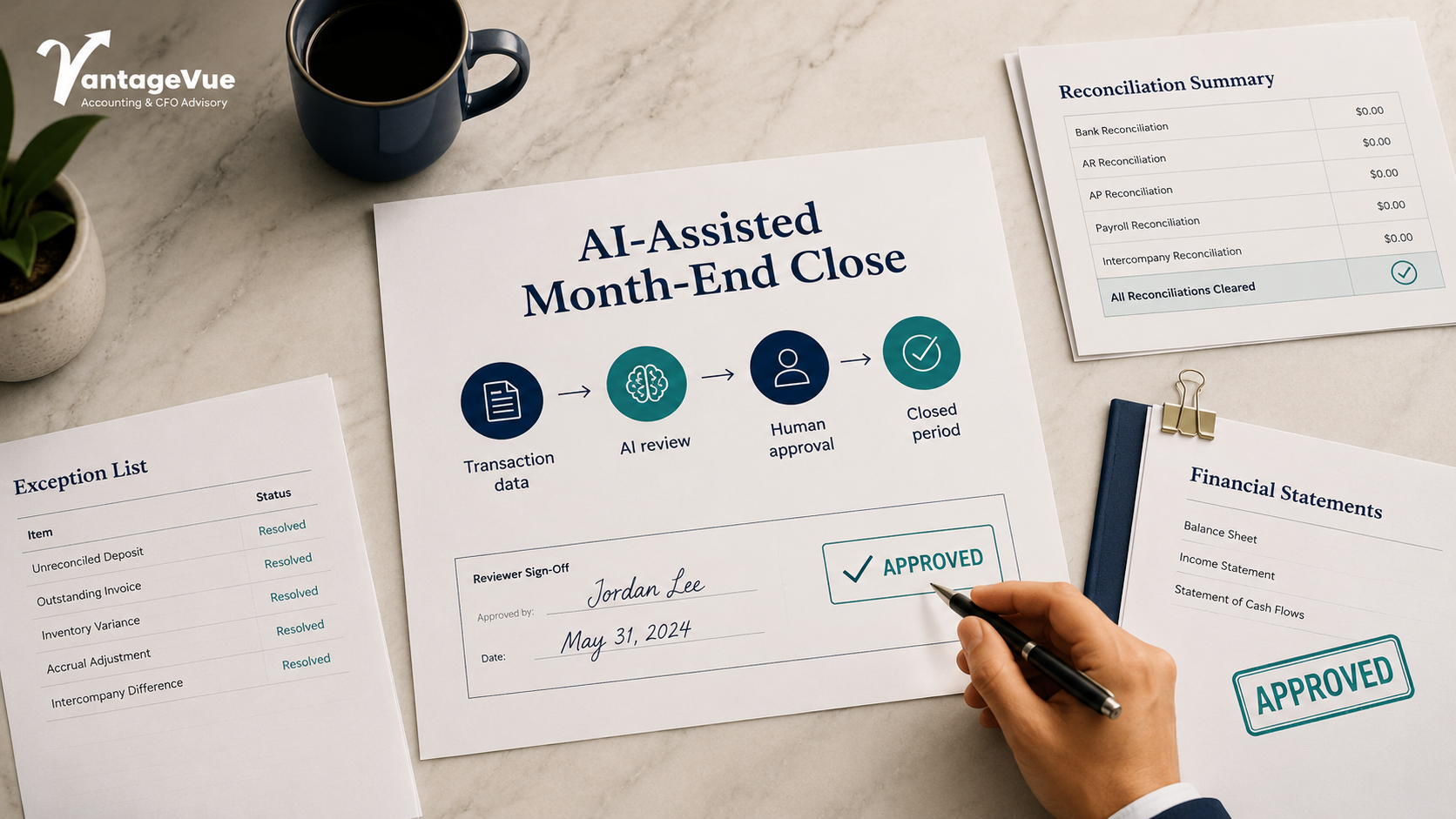
The controller should establish a close calendar and make sure reconciliations, journal entries, adjustments, and reviews are completed consistently.
Leadership should know when financial statements will be available and should not need to chase the accounting team each month.
Accounting policies and classifications
The controller should maintain the chart of accounts and help ensure that transactions are recorded consistently.
This may include revenue and expense classifications, fixed assets, accruals, prepaid expenses, and intercompany activity. Consistent accounting allows leadership to compare periods and understand performance more clearly.
Transactional accounting oversight
The controller commonly supervises accounts payable, accounts receivable, payroll accounting, expense processing, bank reconciliations, and fixed-asset records.
The controller may not process every transaction personally, but should be accountable for the quality and timing of the work.
Internal controls and team supervision
Controller responsibilities should also include approval workflows, segregation of duties, system access, documentation standards, and payment controls.
Bookkeepers, payroll staff, and accounts payable or receivable employees may report to the controller. The controller should review their work, establish expectations, and reduce dependence on one employee for a critical process.
A well-defined controller function supports the broader work of [building a finance function that scales with the business].
Where the Controller Should Support, but Not Own
The distinction between a controller and CFO does not mean that controllers only record transactions and never contribute to analysis.
A capable controller may prepare forecast inputs, board schedules, due-diligence documents, and KPI reports. The important question is who owns the assumptions, recommendations, and final decisions.
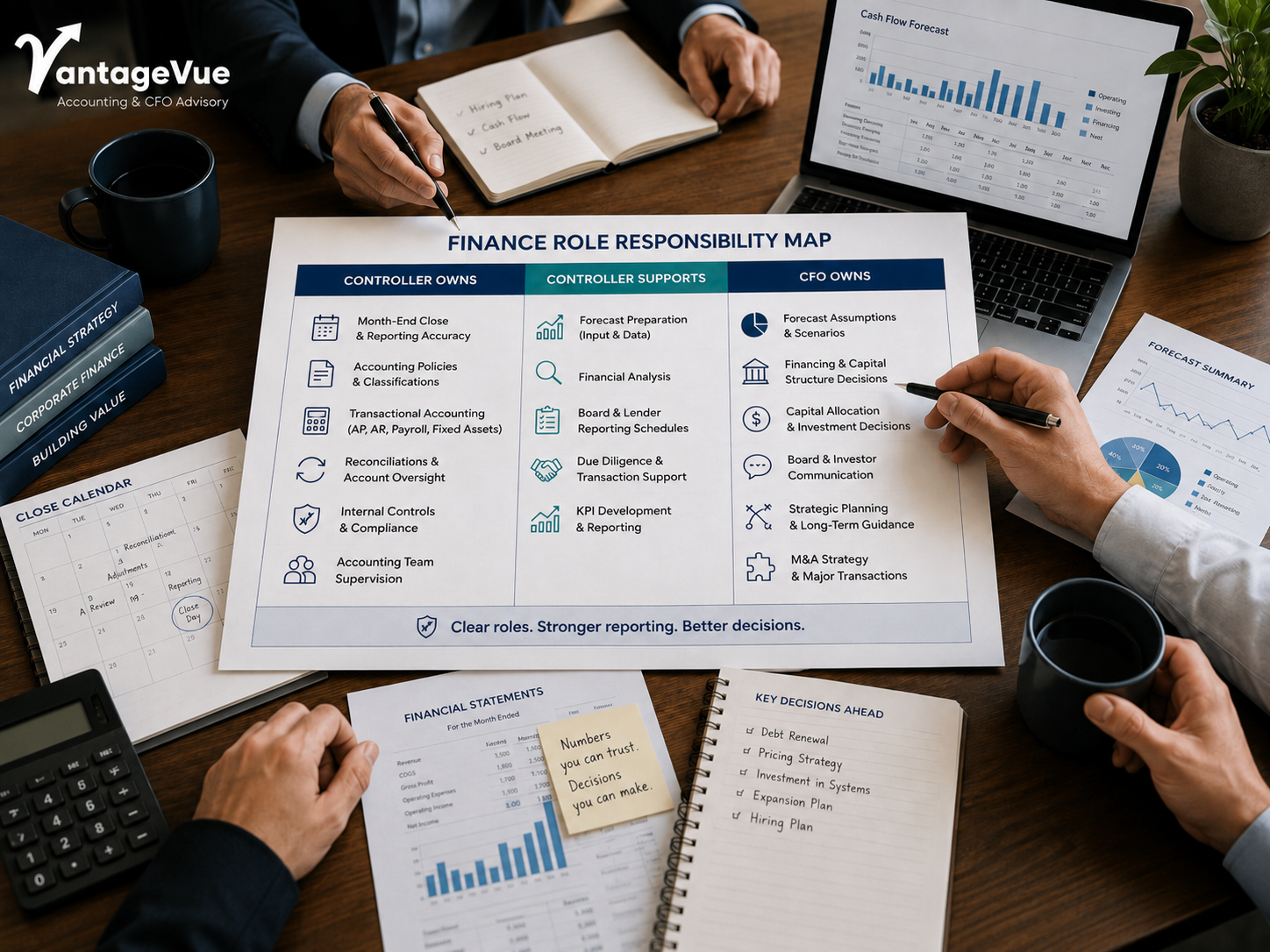
The controller generally owns:
- Close procedures and reconciliations
- Accounting policies
- Transactional accounting
- Internal controls
- Accounting-team supervision
The controller may support:
- Forecast preparation
- Financial analysis
- Board and lender reporting
- Due-diligence requests
- KPI development
The CFO or financial leadership should own:
- Forecast assumptions and scenarios
- Financing recommendations
- Capital allocation
- Board-level financial communication
- Transaction strategy
- Long-term financial planning
This structure allows the controller to contribute valuable information without being expected to carry responsibilities outside the authority or intended scope of the role.
Forecasting and Strategic Decisions
A controller should provide accurate historical information and may help collect assumptions from operating teams.
However, a useful forecast requires more than extending prior results. It may need to consider hiring plans, customer behavior, pricing changes, seasonality, sales pipeline expectations, capacity constraints, and downside scenarios.
The controller can support the process, but the person responsible for financial strategy should challenge the assumptions, own the final model, and explain what the forecast means for the business.
The same principle applies to financing and capital decisions.
A controller can prepare debt schedules, covenant calculations, cash reports, and lender-requested documents. Decisions about whether to draw on a line of credit, refinance debt, purchase equipment, raise capital, or pursue a transaction require a broader view of risk, future performance, and leadership priorities.
The final recommendation should sit with the CFO function or another qualified financial leader.
Reporting Relationships and Authority
A controller should report to the person who owns financial strategy.
That may be a full-time CFO, a fractional CFO, or the CEO in a smaller organization with clearly documented decision boundaries.
The controller should have real authority over accounting policies, close procedures, documentation standards, and internal controls. At the same time, capital decisions, major financial assumptions, financing recommendations, and board communication should remain with financial or executive leadership.
These boundaries should be established before the employee starts.
The job description should explain:
- Which responsibilities the controller owns
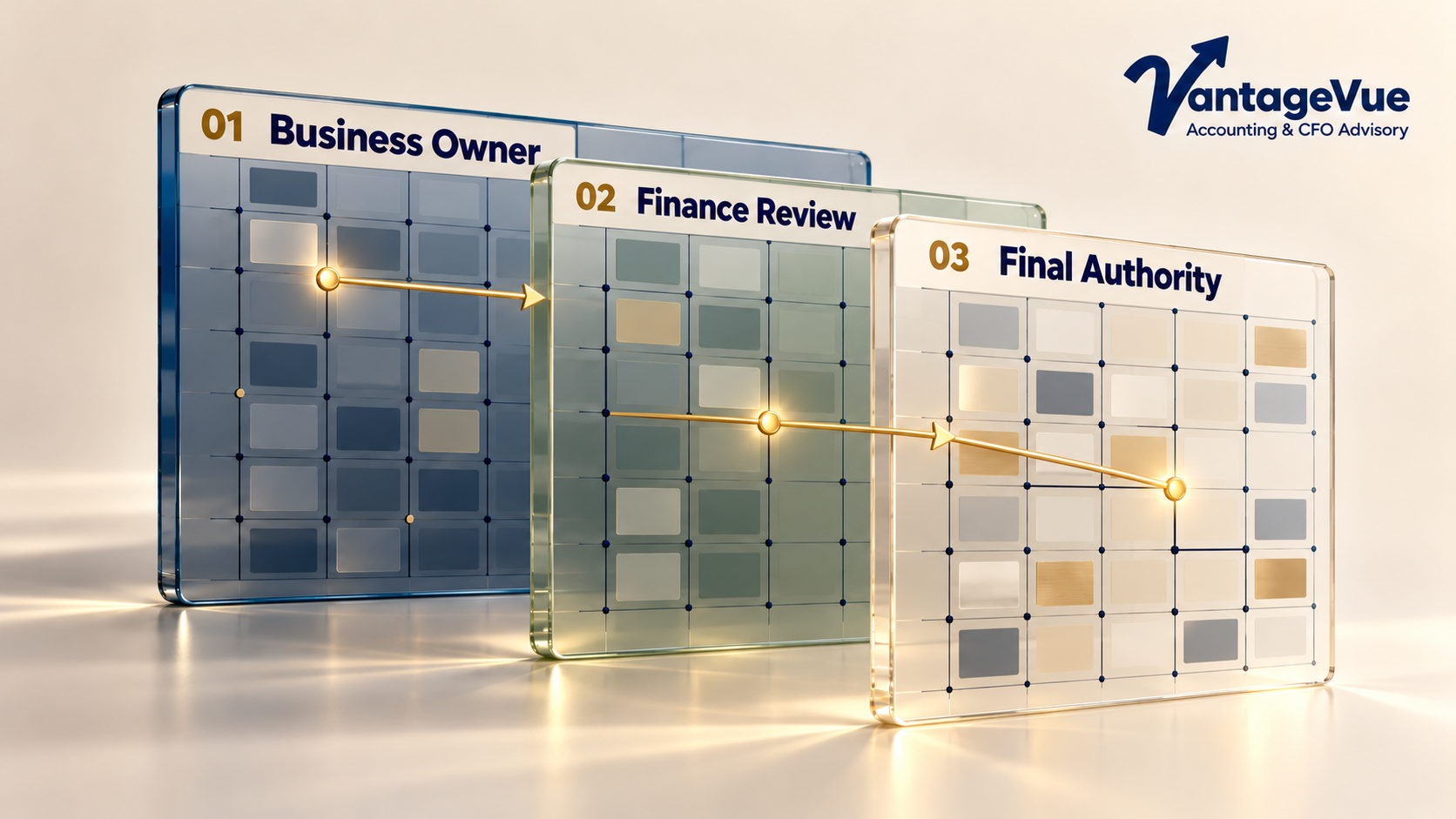
- Which decisions require executive approval
- Who owns forecasting and financial strategy
- Who communicates with lenders, investors, and the board
- How the controller works with outside accountants and advisers
Clear authority helps the controller succeed and prevents strategic responsibilities from being assigned by default.
When the Business Needs Both Functions
A growing company may need a controller and CFO-level guidance at the same time.
That does not necessarily require hiring two full-time executives.
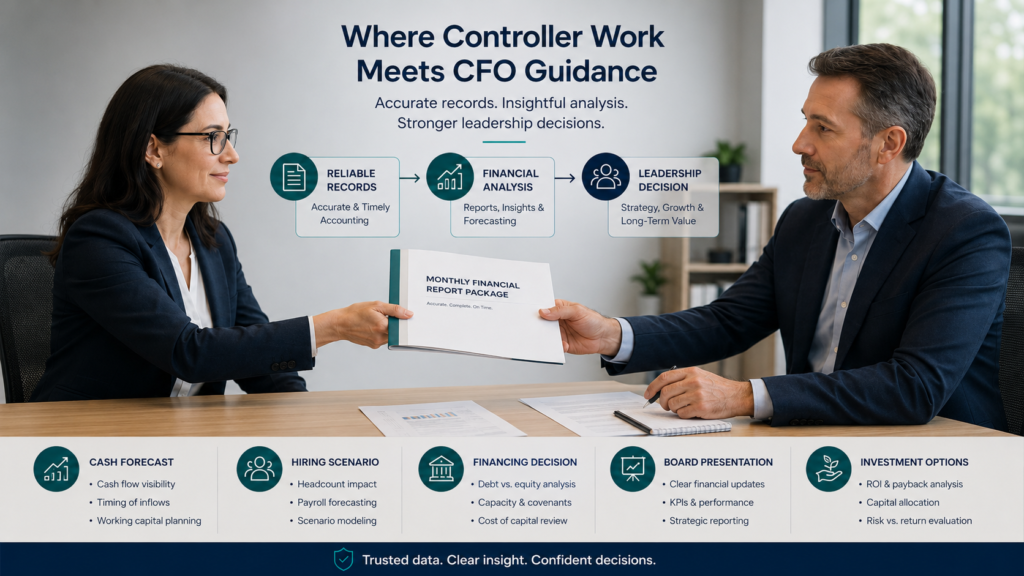
A fractional CFO can work alongside the controller and leadership team. The controller protects the reliability of the financial record, while the fractional CFO helps leadership interpret the information, evaluate scenarios, and make decisions.
CFO-level support may be needed when:
- Leadership is making hiring or investment decisions without a dependable forecast.
- The board is asking questions that historical reports cannot answer.
- The company is approaching financing, an acquisition, or a sale.
- Cash or profitability patterns are changing without a clear explanation.
Businesses assessing whether they have reached this stage can also review [Do You Need a Fractional CFO? 7 Signs It’s Time to Bring Strategic Finance In].
What This Can Look Like in Practice
Consider a growing professional services company hiring its first controller.
Before the hire, the founder personally reviewed payments and checked the trial balance each month. Financial statements often arrived several weeks after month-end.
The controller established a close calendar, improved reconciliations, introduced approval workflows, and gave leadership greater confidence in the financial statements.
Several months later, the company needed a 12-month cash forecast for a debt-renewal discussion.
The controller could provide accurate historical data, but the forecast required assumptions about seasonality, hiring, customer collections, and future demand. Those decisions required leadership judgment and CFO-level review.
The controller had not failed. The business had simply reached the point where accurate accounting and strategic financial guidance were both needed.
Questions to Answer Before Hiring
Before beginning the search, leadership should write two short lists.
The first should define what the controller will own, including the close, reconciliations, accounting policies, controls, and team supervision.
The second should define what remains with financial leadership, including forecast assumptions, financing recommendations, capital decisions, board communication, and long-term planning.
These boundaries should be discussed during the interview process, not introduced after the employee begins.
That clarity helps the candidate understand the position and helps leadership avoid hiring for an accounting role while quietly expecting CFO-level output.
Final Thought
Hiring your first controller should strengthen the accuracy, timeliness, and control of the accounting function.
The controller owns the integrity of the financial record. The CFO function owns the assumptions, trade-offs, and recommendations that shape what happens next.
Both roles are valuable. Problems develop when a company expects one position to perform both functions without the authority, experience, or support required.
VantageVue helps growing companies define controller responsibilities, strengthen accounting processes, and determine where fractional CFO guidance is needed. We work alongside bookkeepers, controllers, executives, and outside advisers to create a finance structure that supports both reliable reporting and stronger decisions.
To learn how VantageVue can support hiring your first controller or clarify controller vs CFO responsibilities, visit our [Fractional CFO Services page] or contact:
VantageVue Advisory
info@VantageVueAdvisory.com
(612) 200-2651