
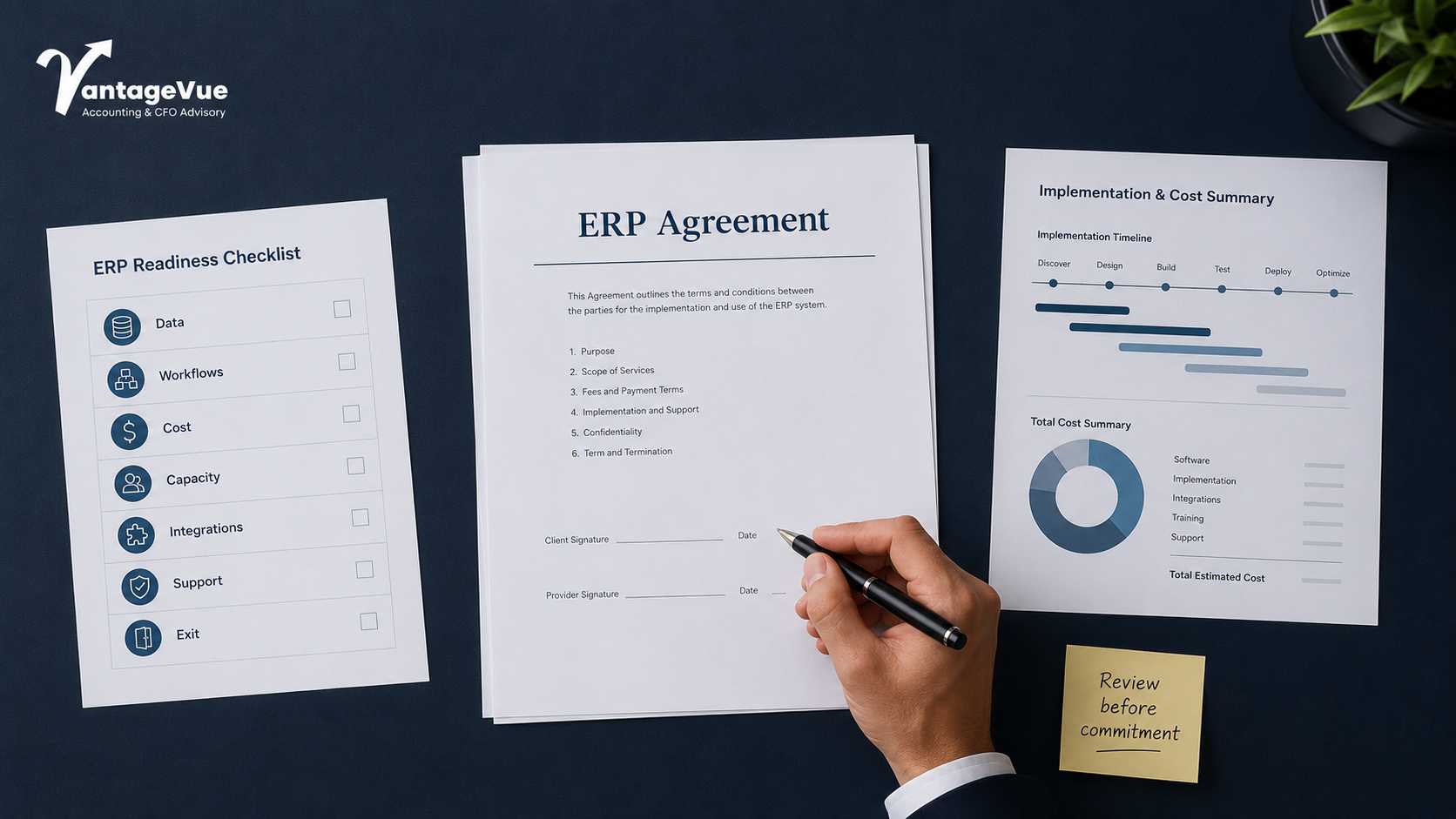
Before signing an ERP contract, finance leaders need to evaluate more than software features. An ERP creates a long-term commitment to a data structure, operating workflow, implementation process, and vendor relationship.
Once the company has invested in migration, configuration, integrations, and training, changing direction can become expensive.
That is why a careful ERP selection should begin with the business problems leadership is trying to solve. Where do approvals stall? Which reconciliations require too much manual work? Why does reporting break down across systems or entities?
Without that diagnosis, a company may choose the platform with the strongest demonstration rather than the one that best fits its operations.
Before signing, answer these seven questions in writing.
1. What Does Our Data Look Like, and Who Will Migrate It?
ERP demonstrations use clean data. A company’s actual records may include duplicate vendors, inconsistent customer names, inactive accounts, unreconciled balances, or years of uneven chart-of-accounts usage.
Leadership should confirm which data will move, how much history will be included, who will clean it, and how opening balances will be validated.
Responsibility must be clear. Migration may involve the vendor, an implementation partner, internal employees, or all three.
A strong finance systems implementation plan should identify who prepares the information, who tests it, and who gives final approval before go-live.
2. Which Workflows Are We Trying to Improve?
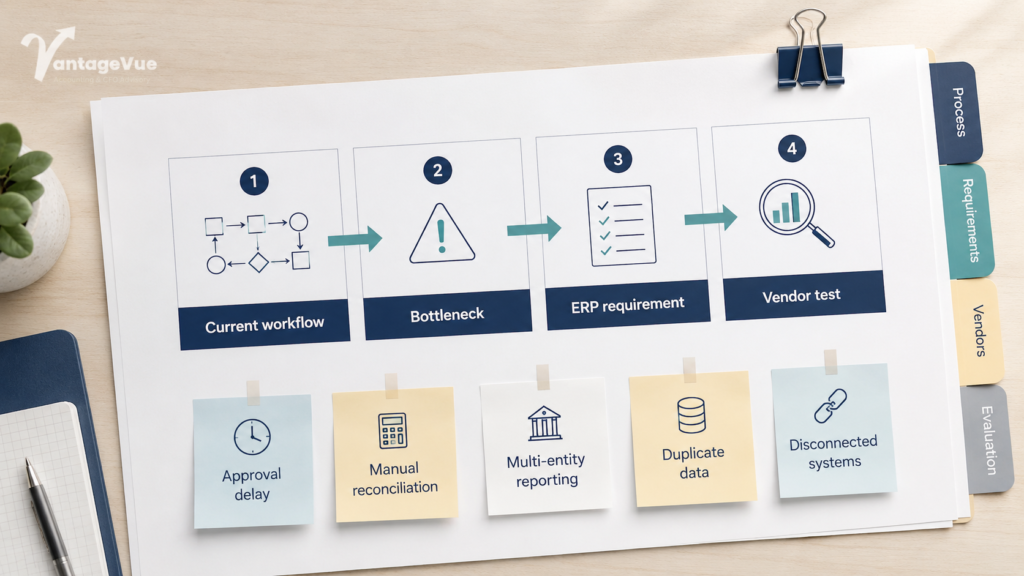
An ERP should solve defined business problems.
Before meeting vendors, document the workflows creating delays, errors, or unnecessary manual effort. These may include purchasing approvals, customer billing, reconciliations, payroll coordination, multi-entity reporting, inventory accounting, or month-end close.
Every vendor should be tested against the same requirements.
For example, when manual intercompany activity is delaying the close, the evaluation should examine how the platform records, matches, eliminates, and reports those transactions.
The best ERP is not the one with the most features. It is the one that improves the workflows that matter most.
3. What Is Included in the Total Cost?
The subscription price is only one part of the investment.
Additional users, entities, modules, API access, transaction volume, training, custom reports, storage, and support may create extra costs.
Ask the vendor to model realistic growth scenarios. What happens to pricing when the business adds another entity, expands its finance team, or requires a new integration?
Internal time should also be included. Employees may need to clean data, define workflows, test transactions, attend training, and validate reports.
The financial model should reflect the complete implementation and operating commitment, not only the software license.
4. What Will Implementation Require From Our Team?
An ERP implementation cannot be completed entirely by the vendor.
The controller, accounting team, IT resources, department leaders, and executive sponsor may all need to provide business knowledge, review configurations, test workflows, and approve decisions.
Leadership should understand who will participate, what each person must deliver, and which normal responsibilities may be affected.
A project may appear manageable on a vendor timeline while creating significant pressure internally.
Before signing, decide how month-end close, audits, budgeting, payroll, and other critical work will continue while key employees are supporting implementation.
5. Will the System Support Our Integrations, Controls, and Reports?
A platform may work well on its own but create problems when connected to the rest of the business.
Finance should review connections with banking, payroll, billing, expenses, inventory, purchasing, and operational systems. Confirm whether each integration is native or provided by another vendor, what it costs, and who monitors failures.
The system should also support appropriate user permissions, approval limits, segregation of duties, audit trails, and changes to sensitive data.
Leadership should test the reports the company will actually use, including entity-level results, consolidated reporting, budget comparisons, cash information, and operating KPIs.
A system should not be approved based only on sample dashboards.
6. Who Will Own and Support the System After Go-Live?
Implementation support is usually well defined. Ongoing support may be less clear.
Ask whether the company will have a named contact or rely on a general ticket queue. Confirm response times, support fees, training options, and responsibility for integrations or report changes.
Internal ownership matters just as much.
Someone should be responsible for user access, workflow changes, reporting definitions, data standards, and vendor coordination.
Without clear ownership, the system can gradually become inconsistent as new accounts, reports, users, and workarounds are added.
7. What Happens if We Decide to Leave?
No company signs an ERP agreement expecting to replace it quickly, but the exit path should still be understood.
Review contract length, renewal provisions, cancellation deadlines, early-termination costs, data ownership, export formats, API access, and post-termination availability.
Ask the vendor to explain the export process in writing.
The company should know whether it can retrieve complete transaction history, supporting detail, attachments, and reporting information in a usable format.
These terms are easier to address before the contract is signed and implementation begins.
When the Wrong Problem Gets Evaluated
Consider a growing multi-entity business selecting an ERP based largely on the vendor demonstration.
Its main problem was a delayed close caused by manual intercompany reconciliations and eliminations. That workflow was not tested carefully during the evaluation.
The implementation improved several accounting activities, but the close remained slow because the original bottleneck was still manual.
The platform was not necessarily poor. The ERP selection process simply focused on broad features instead of the company’s most important problem.
The Practical Takeaway
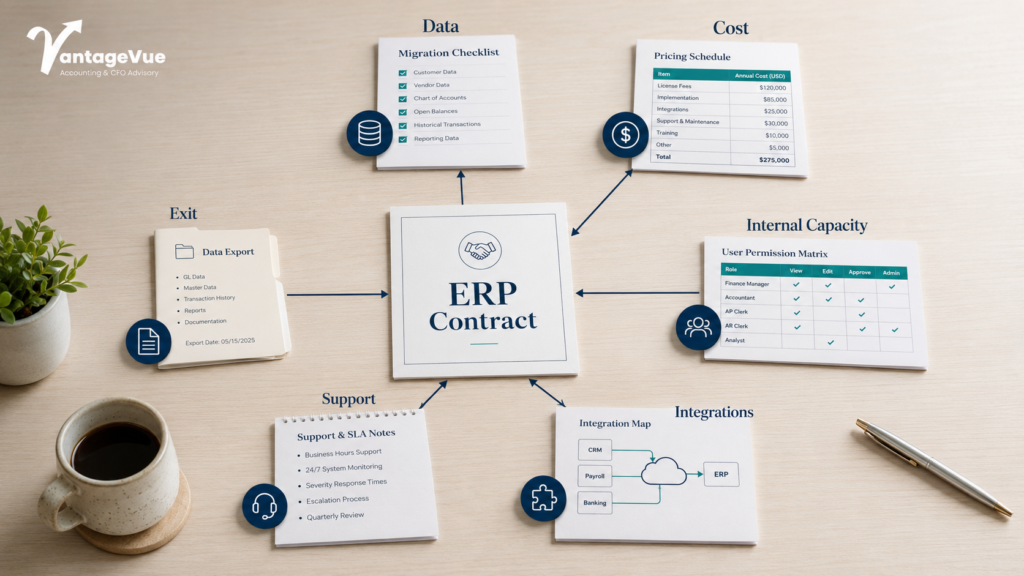
Before the next ERP demonstration, document the company’s workflows, reporting requirements, controls, integrations, internal capacity, and long-term plans.
Bring the same seven questions to every vendor and request written answers where possible.
The best ERP is not the platform with the most polished sales presentation. It is the one that fits the company’s processes, reporting needs, controls, resources, and future direction.
VantageVue helps growing companies diagnose finance workflows, evaluate system requirements, and prepare for stronger finance systems implementation.
To learn how VantageVue can support your ERP evaluation, visit our [Finance Systems and Workflow Cleanup page] or contact:
VantageVue Advisory
info@VantageVueAdvisory.com
(612) 200-2651