
If your annual budget feels outdated the minute it’s finalized, you’re not alone. Fast-moving markets make static budgets hard to trust. Rolling forecasts fix that by turning weekly signals into decisions—so your hiring, GTM, and cash stay aligned. For founder–CFO teams, it’s the difference between chasing the plan and steering it. The best part: you can stand up a reliable rhythm in 30 days.
KEY TAKEAWAYS
- Start lean:8–12 drivers that explain most variance.
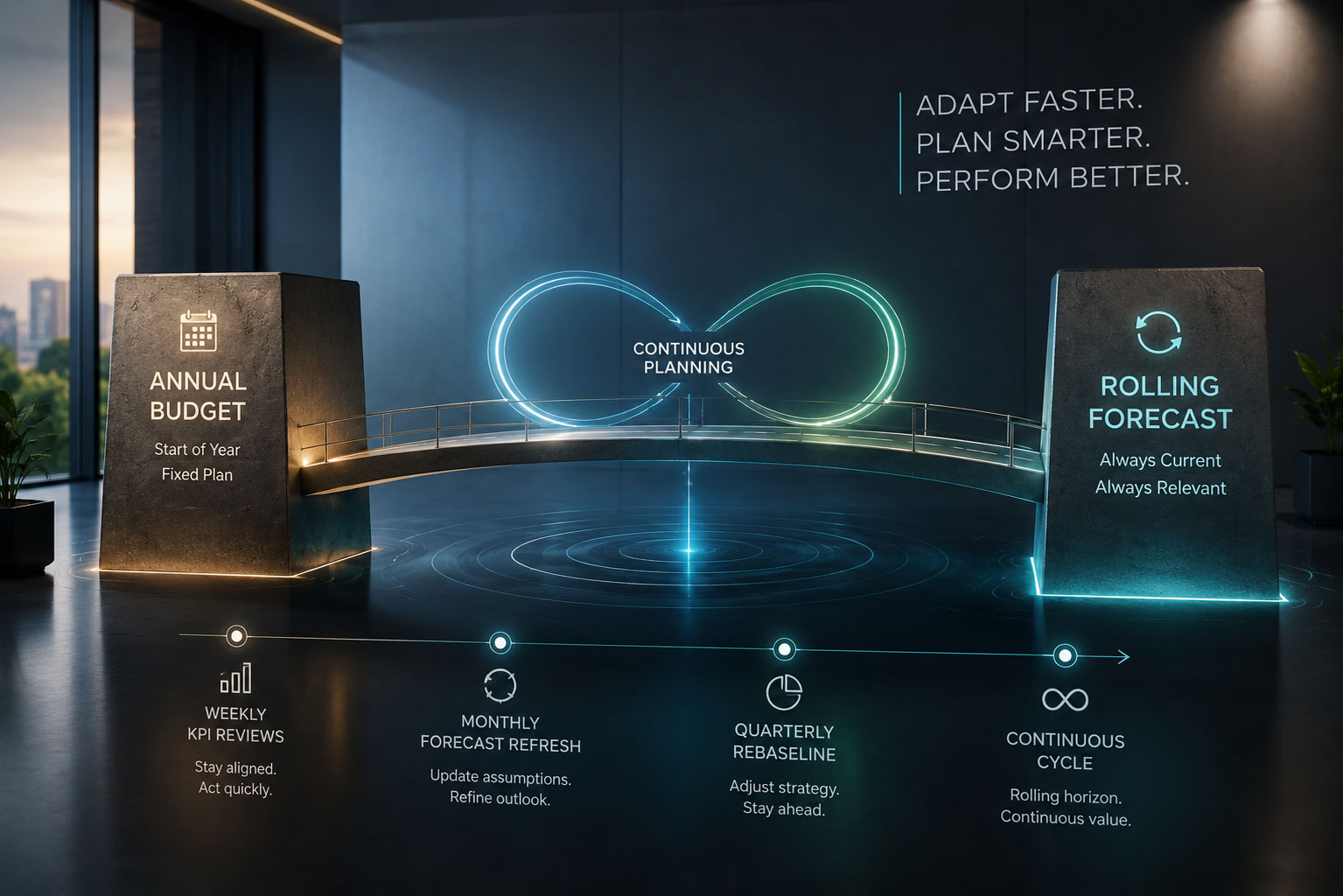
- Protect the rhythm:weekly KPI, monthly refresh, quarterly re-baseline.
- Keep the board on levers:3 cases, driver variance bridge, 2–3 sensitivities.
What a rolling forecast is (and isn’t)
A rolling forecast is a 12–18-month forward view you refresh monthly and re-baseline quarterly. It’s a decision tool, not a spreadsheet hobby. Tie it directly to hiring gates, GTM milestones, and cash runway so it stays useful as assumptions change.
Quick test: If your forecast doesn’t change how or when you hire, you’re reporting—not rolling.
Build the driver tree (make it lean, make it yours)
Start with the fewest drivers that explain most variance. You can add depth later—trust comes from clarity now.
- Revenue:pipeline → win rate → ACV/price → ramp / implementation lag
- COGS/Delivery:utilization, capacity, unit costs, SLA assumptions
- Opex:headcount plan (start dates, comp, benefits), vendor contracts
- Working capital:AR days, AP days, billing cadence, deferred revenue effects
- Cash:runway vs milestones; capex; taxes; debt serviceTry this: Open last month’s deck. Circle the three drivers your board asked about most. Those are your day-one drivers; park the rest.
Related read: Why Every Company Needs a Financial Model: Unlocking the Blueprint to Success.
Workflow & cadence (make the meetings pay for themselves)

- Weekly (30 min):KPI stand-up. What moved in pipeline, hiring starts, cash exceptions? Decide 1–2 actions.
- Monthly (90 min):Refresh the forecast. Roll forward one month, update assumptions, lock the version.
- Quarterly (2 hrs):Re-baseline to actuals. Retire stale assumptions and reconfirm guardrails.Ownership (RACI)
- Finance (model)
- Sales/CS (pipeline/churn)
- HR (starts/comp)
- Ops (capacity/units)Minimum artifacts (checklist)
- Input sheet
- Assumption log
- Change log
- Version-naming rule
Cue: Add a recurring 90-min “Forecast Refresh” to your calendar now. Treat it like a client meeting—no reschedules.
30-day implementation plan (week-by-week wins)
Week 1 — Frame & gather
Scope (12–18 mo), cases (Base/Upside/Downside), and RACI. Pull 6–12 months of bookings, churn, hiring, AR/AP days, unit costs. Set guardrails (hiring gates, minimum cash, pricing floors).
Week 2 — Prototype
Build driver tabs → simple P&L + direct cash view. Add AR/AP timing. Wire hiring start dates into payroll/cash. Smoke-test against the last two months of actuals.
Week 3 — Validate
Review with Sales/CS/HR/Ops; tighten assumptions. Add quick sensitivities (win rate ±5 pts, start-date slips, price ±5%, AR days ±5).
Example: Win rate 22% → 27% adds ≈ $250k ARR in Q3 and moves Hiring Gate B up ~6 weeks—you’ll staff on evidence, not hope.
Example: AR days 45 → 52 cuts Q2 runway by ~3 weeks; revolver risk rises—flag in your CFO note.
Prepare the exec pack shell (three-case view + variance bridge).
Week 4 — Operate
Run your first monthly refresh and weekly stand-up using real inputs. Produce the executive pack: assumptions one-pagers, bridges, runway vs milestones. Publish the cadence (who updates what, when) and lock v1.
What to show leadership/board (keep the meeting on levers)
- Three cases(Base/Upside/Downside) + a one-pager of assumptions per case
- Variance bridge by driver(not by GL account) from last month to this month
- Runway vs milestones(ARR/pipeline gates, launches, hiring gates)
- Sensitivity panelon 2–3 levers (win rate, price, hiring slips)Cue: If discussion drifts to GL lines, ask: “Which driver moved?” Then decide the lever.

Controls that keep it trusted (a few rules, every month)
- Single source of truth:inputs live in one place; no email forks
- Change log:who changed what, when, and why (assumption + evidence)
- Versioning:lock prior versions monthly (e.g., RF_2025-10_v1)
- Revenue rules:document GAAP vs cash logic; never mix bases
- Access:edit = owners; view = stakeholders; archive read-only copiesBottom line: Simple rules, applied the same way every month—that’s what makes your model believable.
Common failure modes (and quick fixes)
- Too many drivers.Prune to the handful that move results; park the rest.
- No clear owner.Finance owns the model; business owners supply inputs on schedule.
- Static hiring dates.Gate hiring to pipeline/ARR thresholds; surface slips.
- Spreadsheet drift.Freeze structure; only touch driver tabs; log changes.
- Case inflation.Tie Upside to explicit levers (+5 pts win rate) and evidence, not hope.
Foundational Forecast Governance (Day-One Setup)
- Driver tree(diagram or list with formulas)
- Assumption log(metric, owner, source, refresh cadence)
- Change log(date, owner, change, rationale)
- Versioning rule(naming + locking)
- Exec pack template(three-case page, variance bridge, runway vs milestones)
CTA
In 30 days, you can replace budget firefighting with a living plan tied to levers you control—hiring, GTM, delivery, and cash. Run the cadence, keep drivers lean, and make decisions off the bridge and sensitivities.
Want a jump-start? We’ll run your first 30-day cycle and hand you the cadence—book a complimentary consult.
e. info@VantageVueAdvisory.com
p. (612) 200-2651