
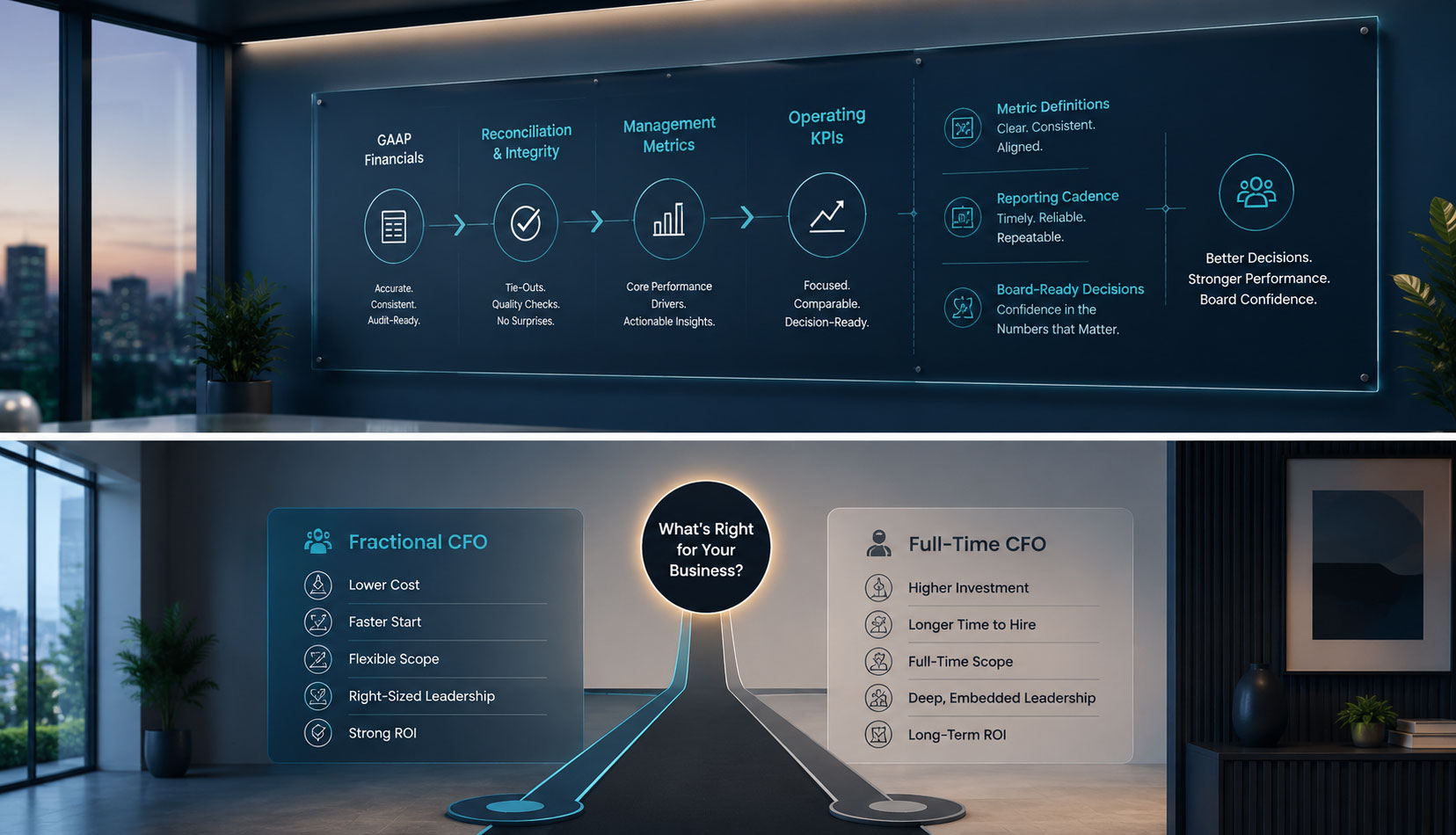
You don’t pick a CFO model—you pick outcomes. This guide gives you reproducible math (scope, utilization, cost stack, scenarios, and break-even) so you can decide which option delivers more value in the next 6–12 months without jeopardizing cash.
Who this is for: Founder–CFO teams at ~$10M–$150M revenue deciding between fractional support and a first FTE.
KEY TAKEAWAYS
- Start with scope & utilization, not titles.
- Compare all-in cost per outcome(not per hour).
- Run Base / Downside / Upside for 6–12 months and apply a simple break-even
What the decision is (in plain English)
Best when (Fractional)
- Sub-$50–$150M or transformation windows (fundraise, lender package, pricing overhaul, system upgrade).
- You need senior judgment fast(8–20 hrs/week) with named deliverables.
- Interim coverage while hiring or leveling up the team.Best when (FTE)
- Scale stage with steady weekly leadership load: manage finance/RevOps, lenders, audits, board cadence, cross-functional planning.
- Persistent needs that reliably consume 40+ hrs/week.Criterion:Choose the model that hits your next three milestones fastest with the lowest cash risk. Quick test: List your next 3 milestones. If two or more are discrete projects (lender memo, forecast rebuild, pricing work), you’re likely fractional now, FTE later.
Scope & utilization (the inputs that matter)
Scope checklist
- Strategic finance & planning (model, scenarios, board package)
- FP&A cadence (weekly KPI, monthly refresh, quarterly re-baseline)
- Fundraising / banking (debt options, data room, covenant design)
- Controls & close (policies, audit readiness, RevRec)
- Systems (ERP/BI selection, implementation oversight)
- People leadership (hiring plan, coaching controller/analysts)
Utilization bands
- 8–10 hrs/wk= light guidance & project leadership
- ~20 hrs/wk= build/transform (model, debt process, pricing)
- 40+ hrs/wk= operate/scale (team mgmt, lenders, board cycle)Try this: Write your 3 milestones and put a monthly hour estimate next to each. That list is your utilization plan.
Cost stack (compare apples to apples)
Full-time CFO (FTE) all-in monthly
= salary + benefits + payroll taxes + equity comp (amortized) + overhead
Fractional CFO monthly
= rate × hours + travel/tools (if any) + optional on-site days
Formula: Cost-per-Outcome = All-in Monthly Cost ÷ Outcomes Delivered (milestones/month)
Illustrative ranges (your market will vary)
- FTE all-in:$28k–$45k / month (cash + benefits + taxes; equity amortized separately)
- Fractional:$250–$500 / hr; common packages $12k–$35k / month depending on scope & hours
Clarify upfront: Equity—show separately or amortize; be explicit. Benefits/taxes—use your actuals. Don’t compare list rates to fully loaded cash.
Quick test: If a model looks cheaper per hour but slower to milestones, your cost-per-outcome is likely worse.

ROI levers (what actually creates payoff)
- Speed to milestone:exec pack live, lender term sheet, pricing changes shipped
- Cash impact:DSO/DPO improvements, opex reductions, vendor terms
- Risk reduction:covenant headroom, audit readiness, RevRec accuracy
- Leadership bandwidth:CEO/COO time reclaimed for GTM and productCue: If the model won’t move cash collected or decision speed inside 90 days, you’re buying optics—not outcomes.
6–12 month scenarios (Base / Downside / Upside)
All cases share the same timing and utilization framework; only the stated levers change.
| Model | Monthly Cost | Milestones / Month | Cash Impact (Run-Rate) | Cost-per-Outcome | Notes |
| Fractional (Base) | $20,000 | 1.5 | $40,000 | $13,300 | Forecast + lender pack |
| FTE (Base) | $35,000 | 2 | $50,000 | $17,500 | Team mgmt + board cadence |
| Fractional (Down) | $20,000 | 1 | $25,000 | $20,000 | Vendor delays |
| FTE (Down) | $35,000 | 1.5 | $30,000 | $23,300 | Ramp + hiring drag |
| Fractional (Up) | $20,000 | 2 | $60,000 | $10,000 | Pricing ships on time |
| FTE (Up) | $35,000 | 2.5 | $70,000 | $14,000 | Faster lender + audit prep |
Break-even & decision rule
Break-even (months) = (FTE monthly cost − Fractional monthly cost) ÷ (FTE incremental monthly value)
Worked example: If FTE costs $15k/month more than fractional, but drives $10k more monthly value (faster cash impact + more outcomes), break-even = 1.5 months. If your next critical milestone is 90 days away and liquidity is tight, you may still start fractional now and switch at break-even.
Decision rule: Choose the model that reaches Milestone 3 fastest without breaching your runway guardrail.
Switch criteria (keep this visible)
- ARR/scale milestone hit (e.g., $30M ARR)
- Steady weekly leadership load ≥ 35–40 hrs
- ≥ 2 consecutive months where weekly leadership load ≥ 35 hrs
- Lender/board cadence intensifies (audit, debt package, fundraise)
- Team size requires day-to-day management

Governance & cadence (so the choice stays right)
Cadence
- Weekly KPI stand-up; monthly forecast refresh; quarterly re-baseline.Artifacts
- Scope doc, assumption log, change log, version rule (same system as the Rolling Forecasts post).
- Change log: date, owner, assumption, rationale.
- Versioning: monthly snapshots (e.g., CFO_Model_YYYY-MM.xlsx) for reproducibility.
- Reconciliation note (≤5 lines): what changed, why, and who approved.Contracting tips (fractional)
- Outcome-based SOW, named deliverables, knowledge transfer plan.Onboarding (FTE)
- 30-60-90 with a finance roadmap and explicit “first three wins.”Try this: Add a recurring 90-min Forecast Refreshto the calendar now. Treat it like a client meeting—no reschedules.
Mini case study (tight)
A SaaS firm at $22M ARR faced nine months of runway and a debt renewal. They chose fractional first (20 hrs/wk) to deliver a runway-accurate model, lender data room, and pricing refresh in 8 weeks. Results: DSO −7 days, vendor terms +15 days, pricing +3% → $120k/month cash uplift. At $30M ARR, with board cadence and audit ramping, they switched to an FTE CFO with a 30-60-90 plan. The choice changed when utilization and steady leadership load did.
Sensitivity: what moves ROI the most?
Show deltas using your worksheet; typical high-leverage levers:
- Milestones/month ±0.5 → large swing in cost-per-outcome
- DSO −5 days → faster cash realization
- Vendor terms +15 days on top 3 contracts
- Pricing +2–3% with no volume loss
Common mistakes (and quick fixes)
- Comparing hourly rates instead of cost-per-outcome → use the formula.
- Over-scoping day one → lock 3 milestones, defer the rest to Phase 2.
- Ignoring ramp → fractional can start next week; FTE hiring = 60–90 days.
- No exit/switch plan → set switch criteria(ARR, team size, lender cadence).