

An acquisition may close on Friday. By Monday, the finance team could be managing two accounting systems, different close calendars, unfamiliar balances, and employees who are uncertain about which procedures still apply.
The legal transaction is complete. The financial integration is not.
The first month-end close often reveals unresolved accounting, reporting, and operating differences between the two businesses. It tests whether the combined company can record activity consistently, assign responsibility, explain unusual items, and provide leadership with useful reporting.
The work will vary based on the size and structure of the transaction, the number of entities involved, and the condition of each company’s financial records. Even so, five decisions tend to shape whether the first close remains controlled and understandable.
These decisions are connected. Delayed account mapping can hold up consolidation. Unclear ownership can produce unsupported entries. Both problems can limit what management reporting is able to explain.
1. Decide What Will Be Reported Together—and What Will Remain Separate
Before discussing which accounting system will survive, leadership needs to decide how the two businesses will report results during the transition.
The acquired company may continue using its existing ledger temporarily, with its results mapped into the buyer’s reporting structure. Selected activity may instead move into the buyer’s system immediately. Larger or more complicated transactions may require both entities to close separately before finance prepares consolidated reporting.
Before the first close begins, finance should know which ledgers will remain active, where transactions will be recorded, when consolidation entries will be posted, and how intercompany activity will be handled.
Leadership must also decide whether it still needs separate results for the buyer and the acquired business.
Combining the numbers too quickly can remove information management needs. During the early closes, it may be more useful to present the buyer’s results, the acquired company’s results, consolidation entries, and the combined total separately.
That separation helps leadership distinguish operating performance from transaction timing, integration costs, and acquisition-related adjustments.
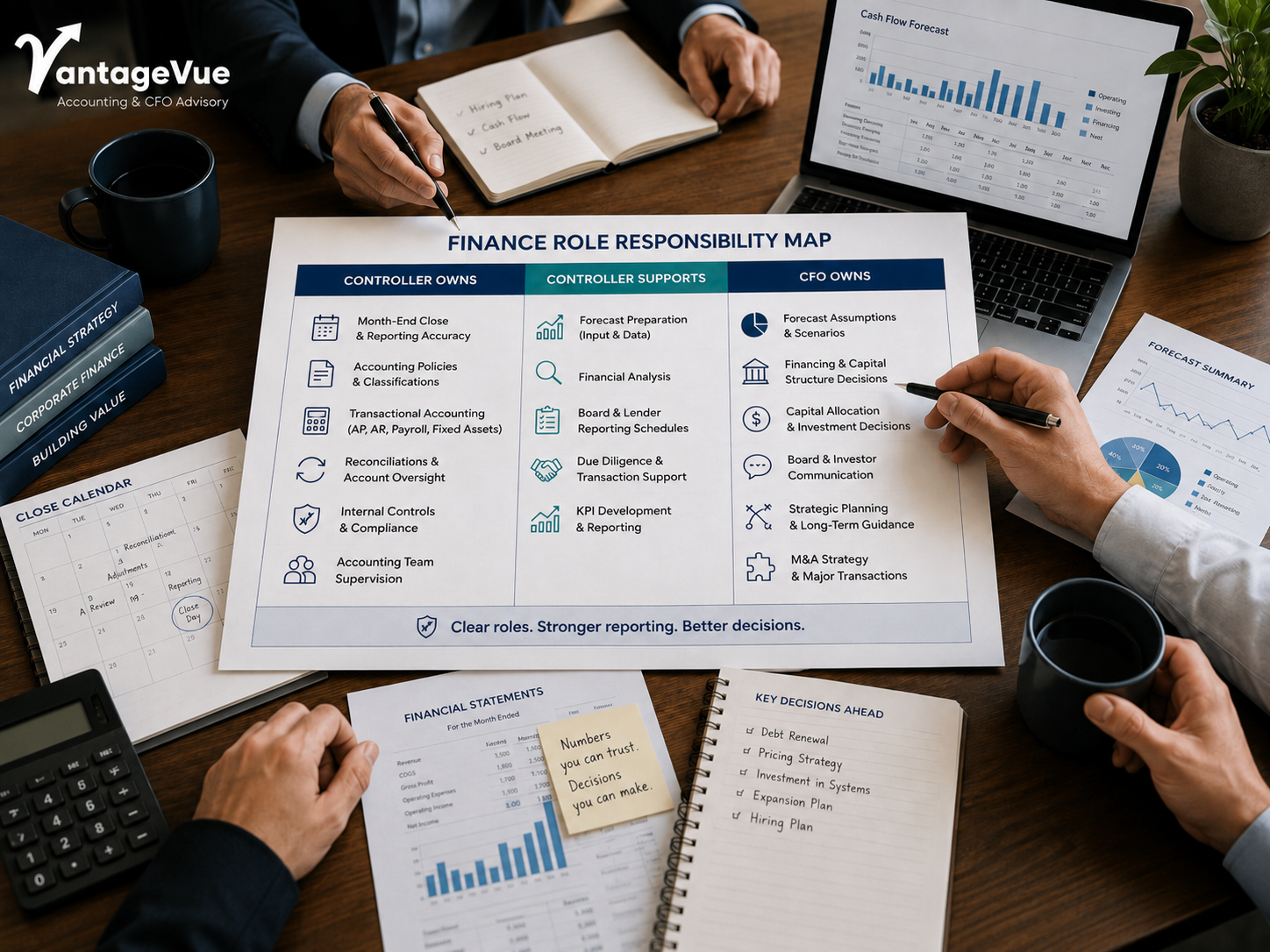
2. Put a Name on Every Close Responsibility
A close calendar only works when each responsibility has a specific owner.
“Accounting will handle it” is not a workable assignment. Every material close task should have a preparer, reviewer, deadline, required support, and escalation path.
This includes bank and balance-sheet reconciliations, payroll, customer billing, vendor invoices, accruals, journal entries, intercompany activity, acquisition-related entries, consolidation, management review, and final approval.
The acquired company’s institutional knowledge also requires attention. Important processes may exist mainly in employees’ experience rather than in formal documentation.
Finance should identify who understands customer billing, who can explain longstanding account balances, who controls bank and system access, who handles payroll exceptions, and who maintains schedules outside the accounting system.
Those people should be identified before the close begins. Waiting until reports are already late increases the risk of incomplete entries and unsupported balances.
3. Align Accounts, Policies, and Opening Balances

Two companies may use the same account name while recording different activity within it.
One business may classify implementation labor as a direct cost, while another treats it as an operating expense. Revenue categories, accrual practices, allocation methods, and business-unit reporting can also differ even when the labels appear similar.
Finance should create a formal account-mapping schedule rather than moving unfamiliar balances into broad categories such as “miscellaneous expense” or “other liabilities.” Catch-all accounts may help finish one close, but they can easily become permanent holding areas for issues no one returns to investigate.
For each account, the mapping schedule should record:
- The corresponding account in the buyer’s structure
- Differences in accounting treatment
- The person approving the mapping
- Available supporting documentation
- Remaining questions or exceptions
Opening balances require the same discipline. Cash, receivables, payables, debt, deferred revenue, fixed assets, inventory, accrued expenses, and acquisition-related entries should be reconciled to the available support.
Under U.S. GAAP, business-combination accounting is addressed by FASB Topic 805. When the initial accounting is incomplete, provisional amounts may be reported and later adjusted during the measurement period when new information becomes available about conditions that existed at the acquisition date.
The first close does not need to present every estimate as permanently settled. It does need to distinguish clearly among confirmed balances, provisional amounts, unresolved differences, and items requiring specialist review.
Material acquisition-accounting judgments should be reviewed by qualified accounting professionals rather than resolved through unsupported assumptions simply to meet a deadline.
4. Decide Which Workflows Change Immediately—and Which Can Wait
Trying to redesign every finance process immediately after closing can disrupt the operations the company is attempting to integrate.
Some workflows require prompt alignment. Others may remain temporarily separate while the organization completes a more orderly transition.
Leadership should deliberately decide how bank access, payment authority, payroll, customer invoicing, collections, vendor payments, employee expenses, journal-entry approval, intercompany charges, and financial-system access will operate.
Temporary arrangements can be appropriate, but they should not be informal.
When an existing process remains in place, finance should document who performs it, who reviews it, what evidence is retained, and when the arrangement will be reconsidered. A temporary process without an owner or review date can quietly become permanent.
This matters because responsibilities and system access are changing at the same time. An unclear approval path or poorly managed handoff can lead to errors, duplicate payments, delayed invoices, weak documentation, or inappropriate financial-system access.
Trying to replace every process in the first month usually creates more disruption than progress. The priority is to make sure the processes still in use have clear owners, controls, and responsibilities.
5. Define What the First Management Report Must Explain
A consolidated income statement is not enough. Leadership needs to understand what happened inside the reported total.
The first management package may need to separate:
- Results from the buyer and acquired business
- Consolidation and acquisition-accounting entries
- Transaction and integration costs
- Intercompany eliminations
- Material differences from the deal model or operating plan
- Partial-period effects
- Provisional or unsupported balances
- Cash and working-capital movements
- Matters requiring management action
A timing difference can materially change how the first combined month appears.
For example, the acquired business may contribute only two weeks of revenue during the first reporting period, while the combined company records a full month of certain professional fees or integration costs. Without an explanation, leadership may conclude that margins deteriorated when the result is partly driven by timing and transaction-related activity.
The reporting package should also include a concise issue-and-action page:
| Issue | Financial effect | Owner | Required action | Target date |
| Opening receivable balance requires support | Accounts receivable may change | Controller | Complete reconciliation | Day 12 |
| Intercompany services are recorded inconsistently | Expenses may be misstated by entity | Accounting lead | Approve allocation method | Day 10 |
| Acquired company closes later than the buyer | Consolidated reporting is delayed | Finance manager | Revise the close calendar | Before next close |
This gives leadership something concrete to manage rather than another set of unexplained schedules.
What the First Close Should Produce

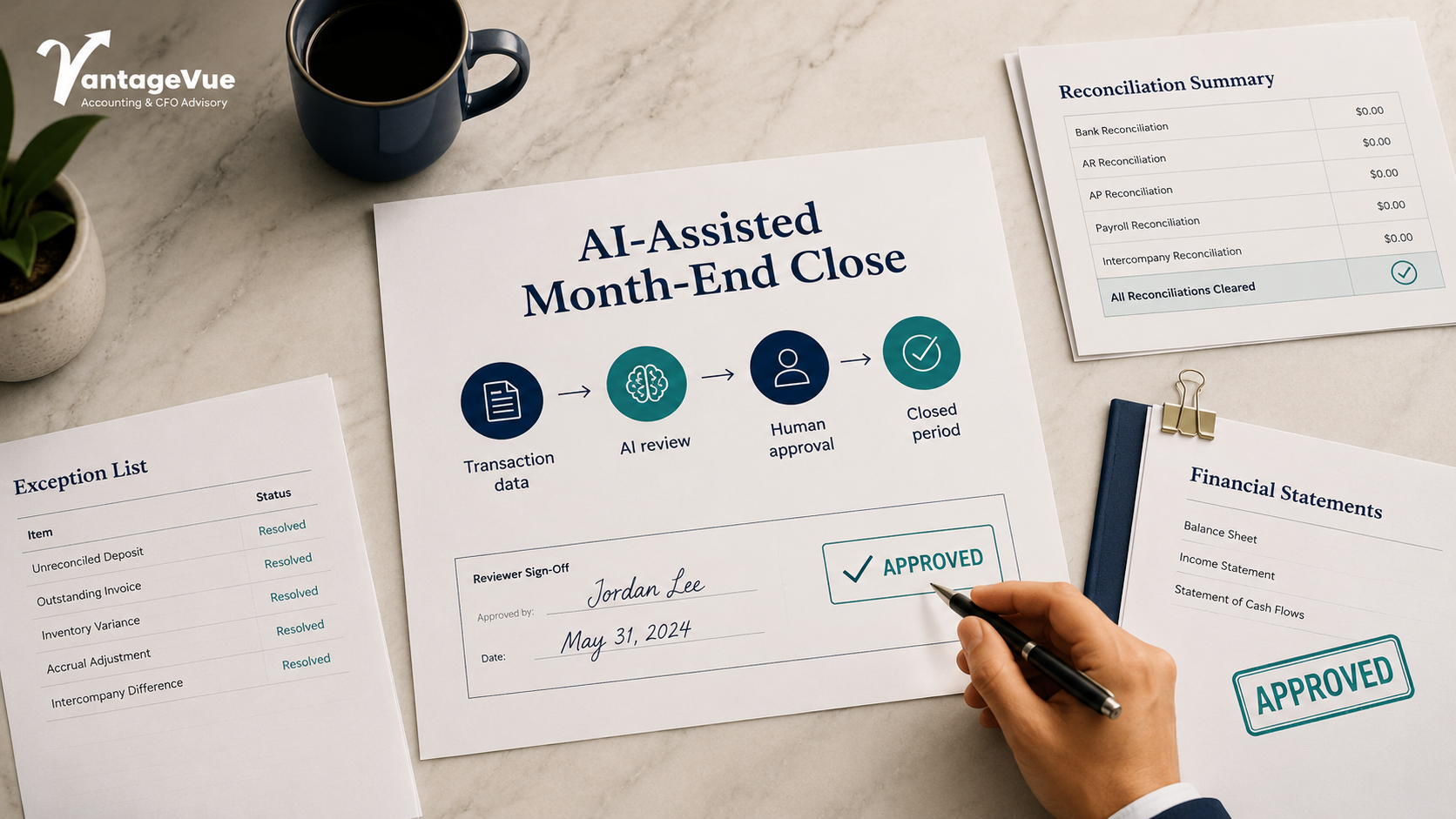
By the end of the process, finance should have:
- An approved reporting structure
- A close calendar with named preparers and reviewers
- An account-mapping schedule and opening-balance issue log
- Documented interim workflows and controls
- A management package explaining adjustments, limitations, and action items
These outputs establish the baseline for the next close and the wider integration plan.
After the First Close
The finance team should review the process while the experience is still recent.
Focus on the issues that affected the timing or quality of the close: late entries, balances without adequate support, unclear responsibilities, manual workarounds that created additional effort, and reports that did not adequately explain the combined business.
The findings should lead to specific changes in the next close calendar. Otherwise, the same problems are likely to reappear.
A successful first close does not mean every ledger, policy, and system has already been combined. It means the organization can explain what has been recorded, what remains separate, which amounts are provisional, and who is responsible for resolving each open item.
That is a realistic standard for the first month—and a strong foundation for the integration work that follows.
VantageVue supports businesses with close-process improvement, financial reporting, account mapping, workflow design, controls, and transaction-related financial planning as an acquisition moves from legal completion into day-to-day operation.
To discuss how VantageVue can support your post-acquisition financial reporting and integration process, contact our team.
info@VantageVueAdvisory.com
(612) 200-2651