

Most businesses treat financial forecasting as a reporting exercise. In reality, it is one of the most powerful drivers of strategic decision-making.
Financial forecasting is not just about tracking performance. It is about creating visibility into what lies ahead and using that insight to guide critical business decisions. In today’s environment, where uncertainty is constant and conditions change quickly, forecasting has become essential to building resilient and scalable businesses.
Forecasting Is Not About Predicting. It Is About Preparing
One of the most common misconceptions is that forecasting is about getting the numbers exactly right.
It is not.
Effective forecasting is about understanding what could happen and preparing the business to respond. Markets shift, costs evolve, and growth rarely follows a straight path. Forecasting provides a structured way to evaluate these variables and plan accordingly.
At VantageVue, we approach forecasting as a dynamic decision-making framework that evolves alongside the business, not as a static financial document.
From Static Budgets to Dynamic Forecasting
Traditional budgeting processes are often rigid and quickly outdated. Businesses that rely solely on fixed annual budgets find themselves reacting to change rather than anticipating it.
Modern financial planning requires a more flexible approach.
Dynamic forecasting allows companies to:
- Continuously update assumptions based on real performance
- Model different business scenarios
- Align financial expectations with operational realities
This shift from static budgets to rolling forecasts enables leadership teams to stay proactive and make informed decisions with greater confidence.
Forecasting as a Strategic Lever for Growth
When forecasting is done well, it becomes a core component of business strategy rather than a back-office exercise.
It directly influences decisions such as:
- Hiring and workforce planning
- Capital allocation and investment timing
- Pricing strategy and margin optimization
- Cash flow forecasting and runway management
Without a structured forecasting process, these decisions are often made in isolation. With forecasting, they are aligned within a broader financial strategy.
Where Businesses Fall Short
- Despite its importance, many organizations struggle to use forecasting effectively.Common challenges include:
- Treating forecasting as a one-time activity instead of an ongoing process
- Failing to revisit and update assumptions regularly
- Disconnect between financial data and operational drivers
- Relying on a single projection instead of scenario planning
These gaps limit the ability to respond to change and reduce the overall value of financial planning efforts.
What Effective Financial Forecasting Looks Like
Strong forecasting does not require unnecessary complexity. It requires structure, consistency, and alignment with how the business operates.
An effective forecasting approach includes:
- Rolling forecasts updated on a regular cadence
- Scenario planning across multiple business outcomes
- Clear linkage between financial metrics and operational drivers
- Outputs that inform decisions, not just reports
The objective is not to generate more data. It is to enable better, faster, and more confident decision-making.
Turning Financial Insight into Action
Forecasting delivers real value only when it is actively used in leadership decisions.
It should help answer questions such as:
- Can we support additional hiring at this stage?
- How does a slowdown in revenue impact our runway?
- Where should we allocate capital to drive the highest return?
- What scenarios should we prepare for over the next two to four quarters?
When forecasting is embedded into ongoing decision-making, it becomes a strategic advantage rather than a financial exercise.
The Bottom Line
Financial forecasting is no longer optional. It is a critical capability for businesses that want to operate with clarity and control.
Organizations that implement structured, forward-looking forecasting gain:
- Better visibility into future performance
- Faster and more informed decision-making
- Stronger financial discipline
- Greater resilience in uncertain markets
At VantageVue, we help businesses build forecasting systems that turn financial data into clear, actionable decisions and long-term strategic value.
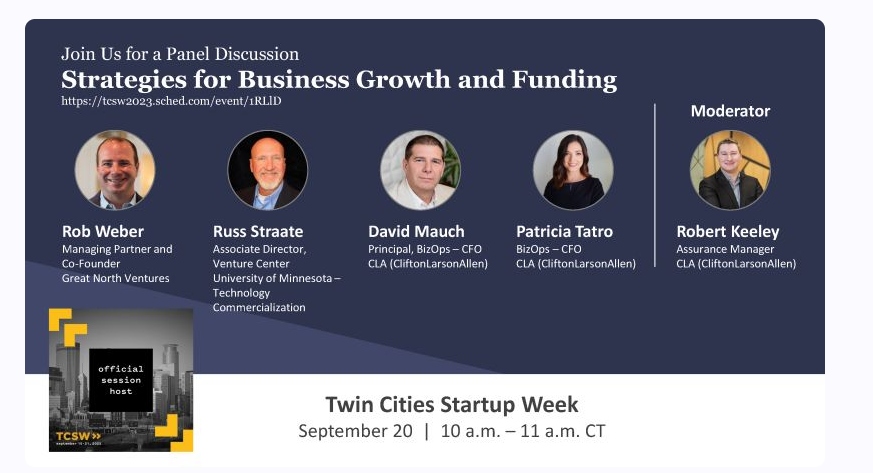
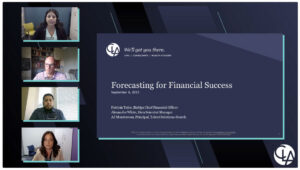
This article builds on insights from the “Forecasting for Financial Success” webinar hosted by CLA (CliftonLarsonAllen) on September 6, 2023.