
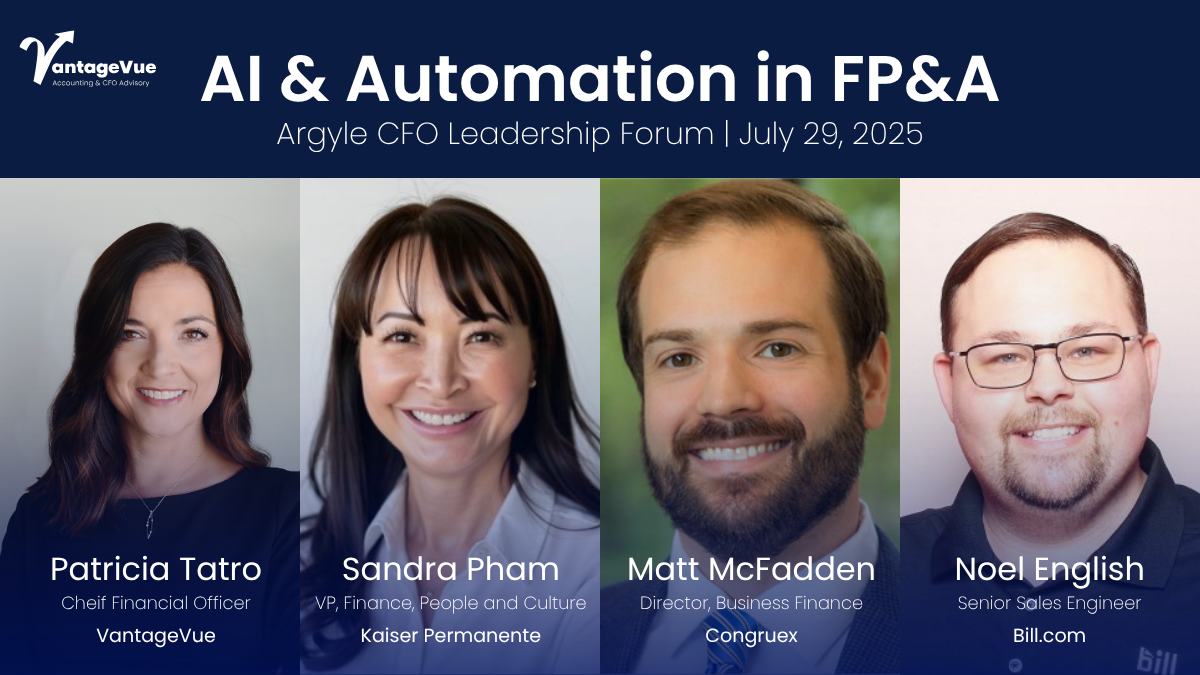
Patricia Wilson Tatro, who is a CPA and the founder and fractional CFO at VantageVue led a discussion about how automation and artificial intelligence are changing the financial planning and analysis field at the Argyle CFO Leadership Forum, which was held online on July 29 2025. The main topic was about using intelligence in a practical way including getting data ready doing focused trials and moving towards ongoing forecasting with human supervision.
Establish the data foundation
The panelists said that making sure your data is clean is the key to using artificial intelligence. Before you start using analytics or forecasting your finance team should make sure your accounts are in order get all your data from the same sources and find the most reliable sources of information. This helps make sure that your sensitivity checks, scenario modeling and variance analysis are accurate.
“AI enhances analysis, but judgment and accountability are still human.”
Where AI adds dependable value today
Current, defensible value is emerging in transactional workflows:
- AP/AR, spend & expense: Artificial intelligence can help with capturing, coding and approving transactions, which reduces the need for manual entry and saves time. This results in ledgers for financial planning and analysis.
- Monthly reports: Automated data collection and standardized key performance indicators save analysts time so they can focus on interpreting the data of just compiling it.
- Trend enrichment: models can look at data and incorporate more sources to help with trend and attrition analysis, including things like employee counts and operating expenses.
These changes help build trust and provide information, which allows financial planning and analysis to work more efficiently.

Predictive analytics for scenario planning
Artificial intelligence can help with planning by speeding up the process of asking “what if” and “what does it take” questions. It can generate scenarios, such as good, better and best as demand signals, pricing and cost structures change. The panel believes that financial planning and analysis should use rolling, forecasting instead of just updating the forecast periodically. They also think that the outputs should be checked against real-world situations and the expert judgment of the finance team.
Integrate without disruption
Three principles for controlled adoption:
- Start small: Select one high-friction, low-risk workflow (e.g., invoice coding) and run a focused pilot.
- API-first: Favor tools that integrate with QuickBooks, NetSuite, and ERP/BI systems without forcing core-stack changes.
- Parallel test: Run new outputs alongside current reports until accuracy is demonstrated; refine assumptions iteratively.
Build tech-curious finance teams
AI elevates expectations for analytical judgment rather than displacing it. Recommendations included:
- Hiring and developing tech-curious analysts who will experiment responsibly.
- Designating tool champions within finance to coach peers and document patterns.
- Reinforcing fundamentals so analysts can assess plausibility, validate AI outputs, and communicate recommendations to operators.
“Someone is accountable—the person, not the model.”
Risk, security, and compliance
Governance and security continue to be crucial:
- Use AI with an enterprise license; refrain from uploading private data to the public.
- Examine suppliers for SOC 2 (as well as any other relevant controls).
- To support audit and management inquiries, maintain explainability by recording assumptions, logic paths, and review procedures.
Governance note: Publicize usage guidelines (what data is allowed, where prompts and outputs should be stored, and approval pathways for access) even before an enterprise rollout.

The near-term outlook (3–5 years)
Given finance’s responsibility for data integrity, adoption will likely be deliberate and practical:
- Expanded month-end automation and continuous forecasts.
- Improved document understanding (e.g., line-item extraction and coding).
- A shift in FP&A effort from reconciliation to operator engagement, recommendations, and decision support.
Argyle CFO Leadership Forum — “Leveraging AI & Automation for Smarter Financial Planning,” July 29, 2025 (virtual).
For more details Click Here or link below to watch the video.