
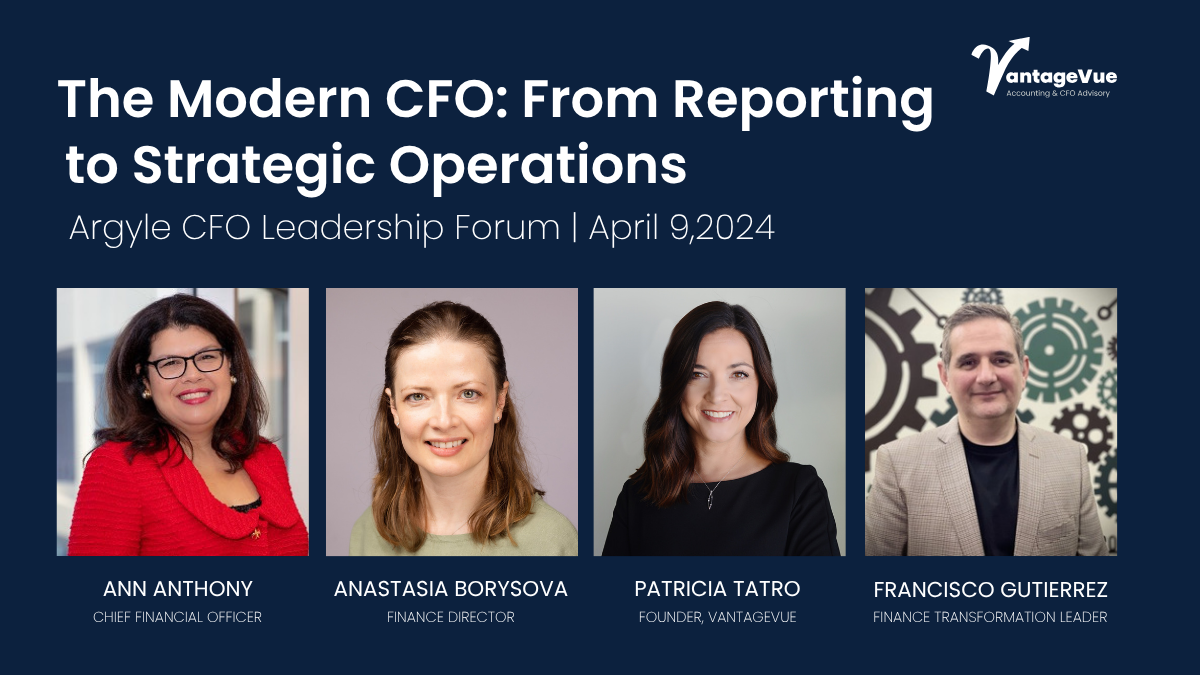
At the Argyle CFO Leadership Forum — “Resilient Finance 2024,” held virtually on April 9, 2024, finance leaders gathered to discuss how CFOs are navigating emerging challenges through AI, automation, data-driven decision-making, and evolving talent strategies. Among the speakers, Patricia Wilson Tatro, Certified Public Accountant and Founder & Fractional CFO at VantageVue, contributed to the discussion on the shifting role of finance leaders—from traditional reporting toward strategic, technology-enabled operations.
Data and technology: build on cloud, automate where mature
Panelists emphasized cloud ERP/BI to reduce obsolescence risk and keep core systems current. On that foundation, automation and AI should target well-structured workflows with clear returns—AP/AR capture and coding, close activities, and standardized KPI packages. These operational improvements shorten cycle times and supply cleaner inputs for FP&A and operator discussions.
Patricia underscored pairing technology upgrades with explicit ownership of data quality and a single source of truth.
“AI augments analysis; accountability remains human.“

Scenario planning: make it continuous
These days teams are moving away from updating forecasts every now. Then and are instead making forecasting a continuous process. AI can help with scenario planning, including looking at what-if and what-does-it-take scenarios while the finance team makes sure the outputs are realistic and take into account things like unit economics and risk thresholds. The goal is to make decisions have a tighter range of possibilities and have fewer surprises.
Collaboration: co-building plans with operators
The relationship between the finance team and the rest of the business is very important. It relies on clear communication, shared goals and regular reviews of our strategy. Of just giving the other teams a finished model to comment on the finance team is increasingly working together with the sales, operations and product teams to build plans run live scenarios, document assumptions and agree on guardrails and leading indicators.
Governance, risk, and resilience
Technology adoption advances with data governance and security controls:
- Use enterprise-licensed AI; avoid public uploads of confidential information.
- Select SOC 2–vetted vendors and maintain vendor risk documentation.
- Keep models explainable by recording assumptions, logic paths, and review steps.
CFO scope is also expanding into business continuity—monitoring geopolitical risk, supply-chain exposure, cybersecurity, and regulatory change—supported by contingency plans and tested playbooks.

Team capabilities for the modern finance function
High-performing teams combine:
- Tech curiosity to experiment with API-driven workflows.
- Analytical judgment to assess plausibility and communicate recommendations.
- Resilience and ownership through ERP/BI changes and integration cycles.
Key takeaways
- Cloud first; automate where data is ready.
- Institutionalize rolling, continuous forecasting.
- Document data governance and model explainability.
- Hire for curiosity; develop judgment and tool champions.
- Co-build plans with operators; align on guardrails.
Argyle CFO Leadership Forum — “Evolution of the Modern CFO,” April 9, 2024 (virtual).
For more details Click Here of link below to watch the video.