
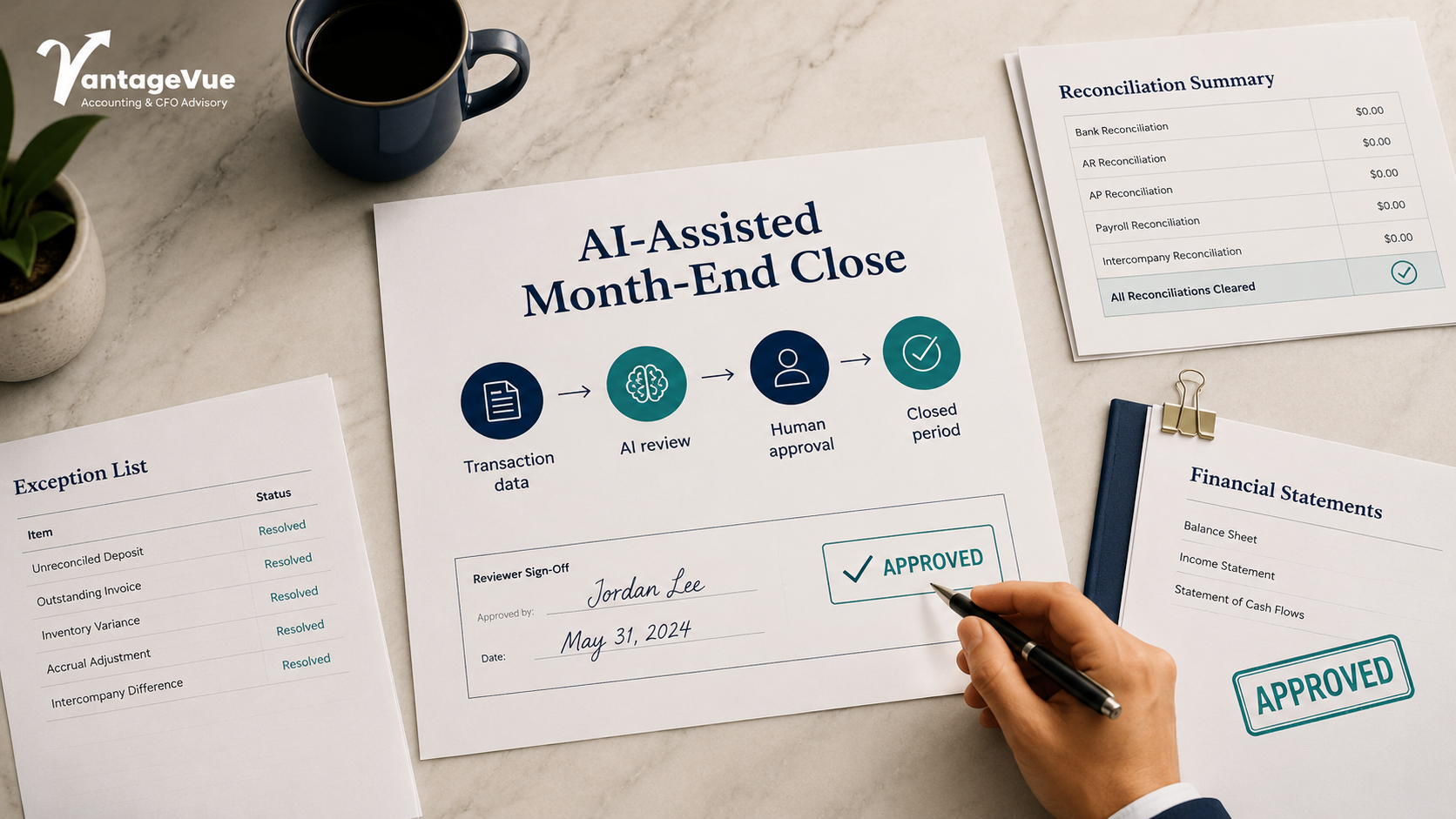
Finance leaders are increasingly being asked whether AI in the month-end close can shorten timelines, reduce manual work, and help teams produce financial information faster.
The answer is yes, but with an important condition.
AI can assist with high-volume, pattern-based work such as transaction coding, reconciliation matching, exception detection, and first-draft reporting. It cannot determine whether every result is correct, whether an unusual item is reasonable, or whether an explanation can withstand scrutiny.
The strongest approach to financial close automation is not to remove human review. It is to use technology to surface information faster while keeping judgment, approval, and accountability with qualified finance professionals.
Not every automated close feature uses generative AI. Some tools rely on fixed rules, pattern matching, or machine learning. Regardless of the technology, finance should understand how the output was produced, how it was tested, and who reviewed it.
Where AI Can Support the Close
Four areas offer clear opportunities for practical AI assistance.
| Close activity | AI can assist with | Human review should confirm |
| Transaction coding | Suggesting account classifications based on prior patterns | New vendors, unusual transactions, policy changes, and one-time activity |
| Reconciliations | Matching routine bank, card, or ledger transactions | Timing differences, duplicate matches, missing support, and unresolved exceptions |
| Anomaly detection | Flagging entries that differ from normal patterns | Whether the item is an error, control concern, or legitimate event |
| Draft reporting | Preparing initial variance summaries and reporting narratives | Whether explanations are supported by actual business activity |
This is the most useful role for AI in accounting today.
The technology can identify possible classifications, matches, exceptions, or explanations. The finance team must determine whether the proposed answer is correct.
Finance should also define which outputs require full review and which can be reviewed by exception. Materiality thresholds, unusual-transaction rules, and approval limits should be documented before automation is introduced.
Transaction coding
AI can learn from historical coding patterns and suggest classifications for recurring transactions.
This may reduce repetitive review when vendor activity and account usage are consistent. However, past treatment may not apply to a new contract, policy change, one-time purchase, or new business activity.
Review should therefore focus on transactions that fall outside established patterns.
Reconciliation matching
Routine matching is well suited to automation. A properly configured tool may reduce the time spent comparing bank activity, credit-card transactions, and ledger records.
A match is not proof that the accounting is correct.
Finance still needs to review timing differences, duplicates, unsupported items, unexpected balances, and matches created from incomplete information.
Anomaly detection
Anomaly detection is one of the clearest practical uses of AI during the close.
The tool may flag an unusually large vendor payment, an entry posted outside the normal cycle, or activity recorded in an unexpected account.
That helps the finance team know where to look.
It does not determine whether the transaction is incorrect. A reviewer must examine the support, understand the business context, and decide whether correction or further investigation is required.
First-draft reporting
AI can help prepare an initial variance explanation or summarize changes between periods.
This may save time, but fluency should not be confused with accuracy.
A well-written explanation can still be unsupported. Before it reaches leadership, the board, a lender, or an auditor, finance should confirm that the narrative agrees with the underlying records and actual operating events.
Data Quality Still Determines the Result
AI will not repair inconsistent accounting practices on its own.
If vendor records, account classifications, approval rules, or historical coding are unreliable, the tool may reproduce those weaknesses more quickly and consistently.
Chart-of-accounts design, reconciliations, documentation standards, and master-data cleanup should therefore be addressed before automation is introduced.
Companies may also find it useful to review [Data Hygiene for Finance: COA Design, Single Source of Truth, and Close Checklists] before adding automation to an unreliable process.
How AI-Assisted Outputs Should Be Tested
AI-assisted work should earn trust through testing rather than receive automatic approval.
Run the AI-assisted workflow alongside the existing process until finance has tested both routine activity and meaningful exceptions. Approval should depend on demonstrated performance, not a fixed number of close cycles.
Testing should include:
- A new vendor
- An unusual journal entry
- A one-time transaction
- A bank-feed or file-format change
- A new entity or business line
- A change in accounting policy
The review should examine individual results, not only whether the final totals agree.
A tool can produce a balanced reconciliation while matching the wrong transactions. It can also prepare a reasonable variance explanation without identifying the true cause.
A practical testing record can follow:
Output tested → Difference identified → Cause → Correction → Approval
The workflow should be tested again when the business, system environment, or transaction patterns change.
Before AI Touches Financial Data
Efficiency should not come at the expense of confidentiality or control.
Before using AI in the close, leadership should confirm:
- What financial information the tool can access
- Where prompts, inputs, and outputs are stored
- Whether company data may be used to train external models
- What security and access controls the vendor provides
- Whether results can be traced and explained
- Who can approve changes to the automated workflow
The technology should fit the company’s information-security standards, accounting policies, and review requirements.
Who Remains Accountable
The person responsible for approving the close remains accountable for the accuracy and completeness of the financial record.
The financial leader who presents the results remains accountable for the interpretation, assumptions, and decisions communicated to leadership.
An AI tool cannot accept that responsibility.
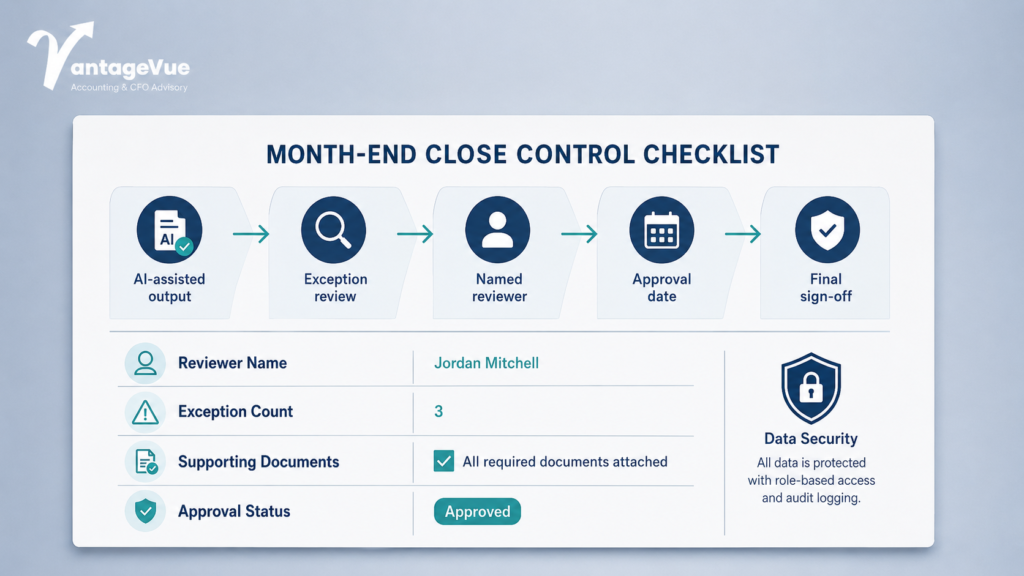
Every AI-assisted close step should therefore include:
AI-assisted output → Named reviewer → Review date → Approval
A practical checklist may include the output produced, exceptions reviewed, corrections completed, reviewer name, and approval date.
The control standard should be straightforward: if no specific person has reviewed and approved an AI-assisted output, the process is not complete.
What This Can Look Like in Practice
Consider a company using AI-assisted bank reconciliation.
At first, the accounting team reviews every proposed match. As confidence grows, review becomes less consistent. A later bank-feed change causes several transactions to be matched incorrectly, but the output appears complete and the errors remain unresolved.
The automation did not create the control failure.
The failure occurred when no one remained responsible for reviewing exceptions and changes in source data.
The Practical Takeaway
AI can improve the month-end close when it is used for repetitive, pattern-based, and first-pass work.
Start with reliable data. Test the tool against routine activity and real exceptions. Protect confidential information. Document who reviews each output, and keep approval with the person responsible for the financial statements.
AI can accelerate the close, but it cannot accept responsibility for the financial statements. Efficiency improves when technology surfaces the work and qualified finance professionals remain responsible for reviewing, approving, and explaining the result.
Vantage Vue helps businesses improve finance workflows, strengthen close procedures, evaluate financial close automation, and introduce technology without weakening accountability.
To learn how Vantage Vue can support your finance systems and month-end close process, visit our [Finance Systems and Workflow Cleanup page] or contact:
Vantage Vue Advisory
info@VantageVueAdvisory.com
(612) 200-2651