
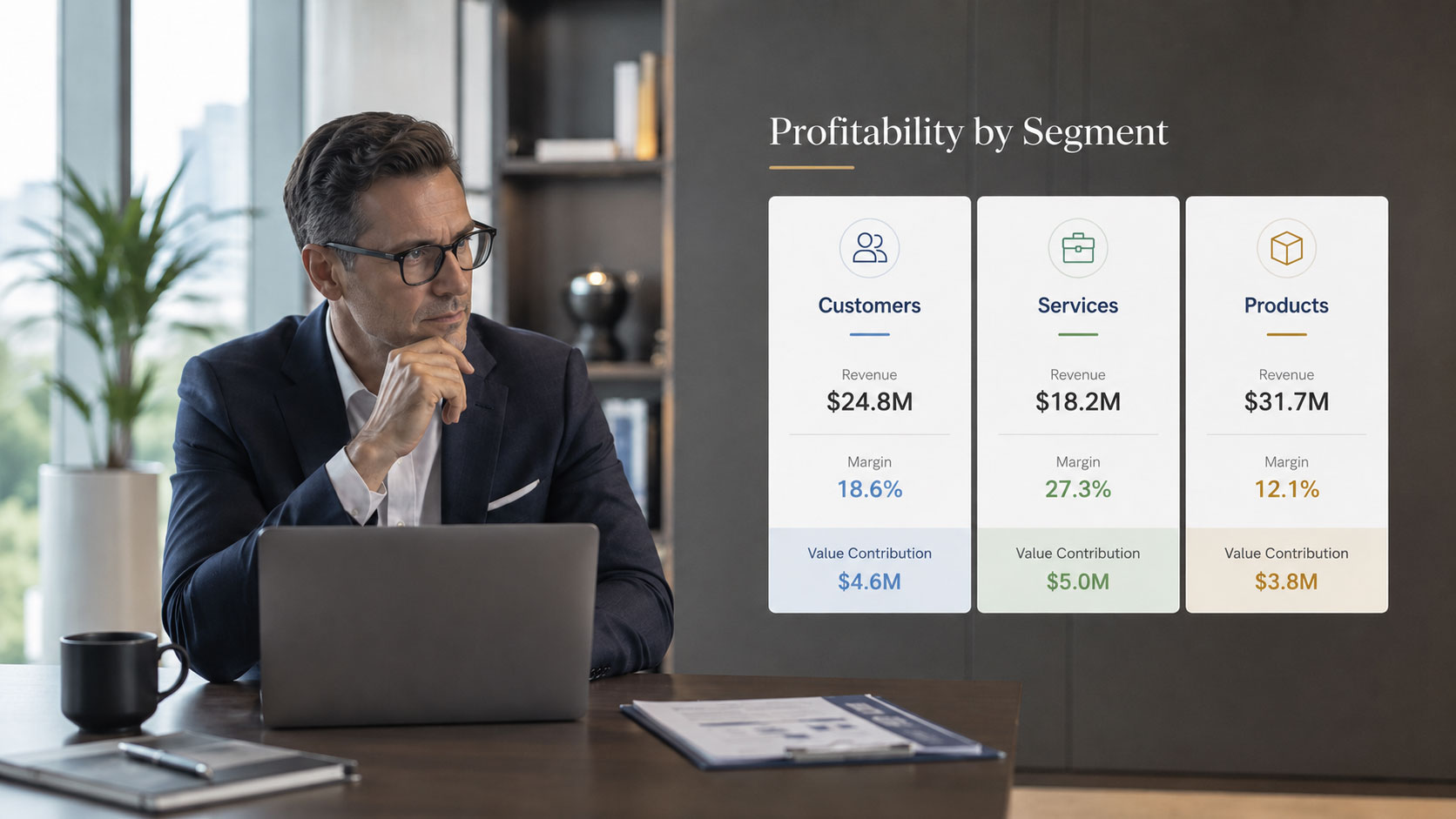
Revenue growth does not always mean profitable growth.
Many businesses track total revenue, expenses, and net income. Those numbers matter, but they do not always show which parts of the business are actually creating value. A company may be growing while certain customers, services, products, locations, or business lines quietly reduce margins and consume more resources than expected.
That is where profitability by segment becomes essential.
Segment-level profitability helps leadership understand which areas drive sustainable profit, which areas need improvement, and where resources should be allocated more intentionally. For growing companies, this insight can shape pricing, staffing, sales focus, service delivery, product strategy, and long-term growth decisions.
Key Takeaways
- Overall profitability can hide major differences between customers, services, products, or business lines.
- Revenue alone is not enough; margins, delivery costs, overhead, customer complexity, and cash behavior matter.
- Segment-level analysis helps leadership see where value is truly being created.
- CFO-level insight can support better decisions around pricing, staffing, sales focus, and growth strategy.
Why Overall Profitability Is Not Enough
A business can appear profitable at the company level while still carrying underperforming segments.
A service line may generate strong revenue but require heavy staffing, frequent rework, or high client support. A product may sell well but carry thin margins after fulfillment, shipping, discounts, and returns. A customer may be large and visible but consume more time and resources than smaller, more profitable accounts.
When leadership only reviews total revenue and total profit, these differences are easy to miss.
Segment profitability gives the business a more useful view by breaking financial results into meaningful categories, such as customer group, product or service line, location, department, sales channel, project type, or industry vertical.
This helps leadership move from broad financial reporting to more practical decision-making.
Revenue Does Not Always Equal Value
One of the most common mistakes growing businesses make is assuming that the largest revenue sources are also the most valuable.
A high-revenue customer may require custom reporting, extra meetings, urgent turnaround times, discounts, or ongoing operational support. A smaller customer may have clearer needs, stronger pricing, lower servicing costs, and better payment discipline.
The same can happen with products or services. A popular offering may look successful because it sells often, but if it carries high delivery costs or low margins, it may contribute less value than expected.
The better question is not only:
How much revenue does this segment generate?
The stronger question is:
How much profit does this segment generate after the true cost of serving it?
That shift changes the conversation.
What to Measure by Segment
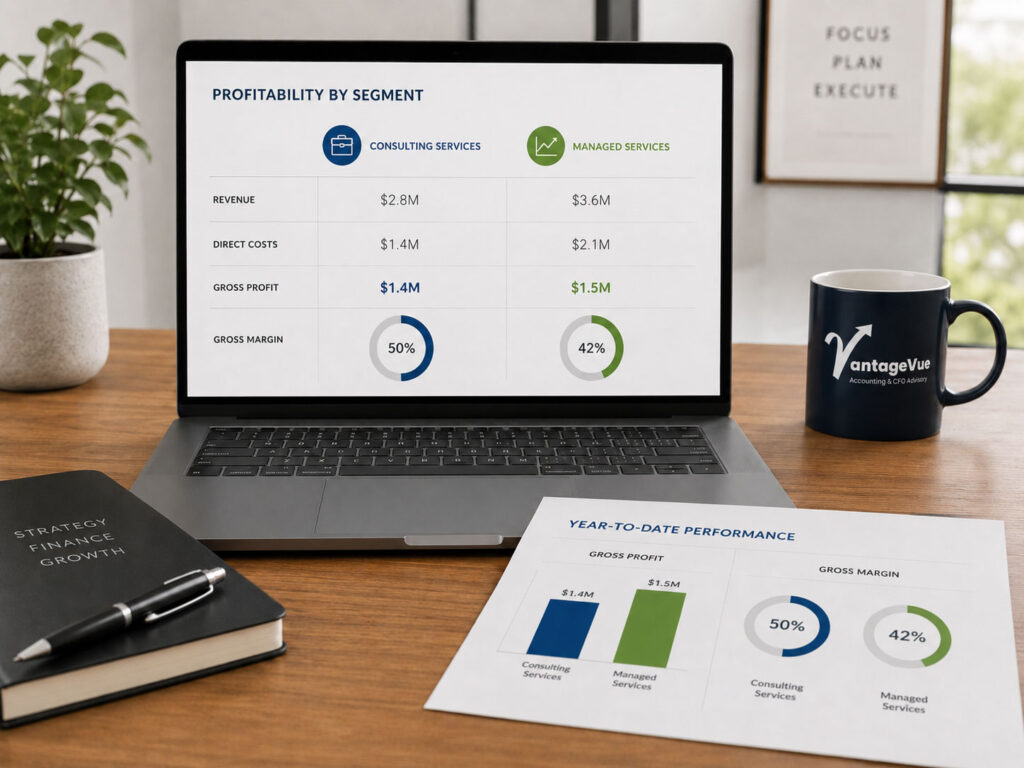
To understand profitability by segment, leadership needs more than a revenue report. A useful segment profitability review should include:
- Revenue: how much each segment contributes to the top line.
- Direct costs: costs tied directly to delivering the product, service, or customer work, such as labor, materials, software usage, subcontractors, shipping, commissions, or direct service costs.
- Gross margin: how much value remains after direct costs.
- Operating support requirements: management time, customer support, implementation work, customization, or administrative effort required by each segment.
- Overhead and cash behavior: shared costs, slow collections, upfront costs, inventory needs, or extended payment terms that affect true profitability.
These categories help leadership see not only what sells, but what actually contributes to stronger financial performance.
A Simple Example
Consider a business with two service lines:
Service Line A: $1,000,000 revenue, $700,000 direct costs, $300,000 gross profit, 30% gross margin.
Service Line B: $600,000 revenue, $240,000 direct costs, $360,000 gross profit, 60% gross margin.
At first glance, Service Line A may look more important because it produces more revenue. But Service Line B produces more gross profit with less revenue.
That insight matters.
If Service Line A also requires more oversight, delivery complexity, and slower payment cycles, the business may be over-investing in a lower-quality revenue stream. Meanwhile, Service Line B may deserve more sales attention, pricing support, and operational capacity.
Without segment-level analysis, leadership may keep chasing revenue that does not meaningfully improve the business.
Common Profitability Blind Spots
Many businesses already have the data needed to evaluate segment profitability, but the information is often scattered across accounting systems, spreadsheets, CRM tools, payroll reports, and operational platforms.
Common blind spots include:
- Services priced based on historical rates or client expectations rather than true delivery cost.
- Customers that require more meetings, revisions, support, or custom work than expected.
- Team time that is not tracked by customer, project, service line, or department.
- Discounts, special pricing, expedited work, or nonstandard terms that weaken margins.
- Segments that look profitable on paper but create cash strain through slow collections or high working capital needs.
How Segment Profitability Supports Better Decisions
Segment profitability is not just an accounting exercise. It is a management tool.
When leadership understands profitability by customer, service, product, or business line, the company can make better decisions around:
- Pricing: identifying where pricing does not reflect delivery effort, complexity, or risk.
- Sales focus: prioritizing customers, products, or services that create stronger margins.
- Staffing and capacity: planning resources around the segments that require the most delivery effort.
- Product and service strategy: deciding which offerings should be expanded, refined, repositioned, or discontinued.
- Customer management: identifying which customers are strategically valuable, which need pricing adjustments, and which require clearer scope boundaries.
- Growth planning: investing in segments that create sustainable profit, not just visible revenue.
This helps the business scale with more discipline.
The Role of CFO Leadership

Building a useful segment profitability model requires both accounting accuracy and strategic interpretation.
The accounting foundation matters. Revenue and costs must be categorized consistently. Direct costs should be mapped correctly. Reporting structures need to support analysis by customer, service, product, or business line.
But the strategic layer matters just as much.
CFO leadership helps translate segment-level data into practical business decisions by asking:
- Which segments are most profitable today?
- Which segments have the best long-term growth potential?
- Which customers or services require more resources than expected?
- Where does pricing need to change?
- Which areas should receive more investment?
- Which areas should be simplified, repositioned, or reduced?
The goal is not to create more reports. The goal is to help leadership understand where the business is truly creating value.
How to Start
Businesses do not need a perfect model on day one. A practical first step is to choose one segmentation view and build from there.
A service business may start with profitability by service line. A SaaS or technology company may start with profitability by customer type or product tier. A manufacturing or distribution company may start with profitability by product category or customer group. A professional services firm may start with profitability by client, project type, or team.
Then build a simple model that compares revenue, direct costs, gross margin, support requirements, and cash behavior across segments.
From there, leadership can refine the analysis over time.
Final Thought
Growth is stronger when leadership understands what is actually driving profit.
Segment profitability helps businesses see beyond top-line revenue and identify which customers, services, products, or business lines create sustainable value. It brings clarity to pricing, staffing, sales strategy, operational planning, and resource allocation.
For growing companies, this kind of visibility can make the difference between scaling complexity and scaling profitably.
VantageVue helps business owners and leadership teams strengthen financial reporting, analyze profitability, and build the financial visibility needed to make better decisions with confidence.
info@VantageVueAdvisory.com
(612) 200-2651